Showing posts with label Buddhist Sutras. Show all posts

Thursday, April 21, 2011

"USNISA VIJAYA DHARANI SUTRA"

This Sutra was once widely circulated and practiced... but owing to turbulent times (caused by natural disasters and calamities), very few people propagated it, and the circulation of this rare and precious Dharma treasure stagnated and ceased, finally becoming silent and unheard of, no longer radiating its Dharma light throughout the universe...

This Sutra is broadcast with the aim that all sentient beings living in the troubled and tumultuous world would benefit from it... that the Sutra would help beings leave sufferings and obtain happiness, increase prosperity and longevity, remove karmic obstacles, eliminate disasters and calamities, remove enmity and hatred, fulfill all wishes and quickly be led onto the Buddha's way... that it could help sentient beings overcome worries and sufferings and more people can be made aware of its importance in the present materialistic life...

The merits and awesome power of Usnisa Vijaya Dharani are in-conceivable...
___________________________________________________________________________________

(Translated version of Master Buddhapala during the Tang Dynasty)

Thus I have heard, at one time, the Bhagavan (World Honoured One) was dwelling in the city of Shravasti at the Jeta Grove, in the Garden of the Benefactor of Orphans and the Solitary (Ananthapindada) , together with his regular disciples of twelve hundred and fifty great Bhikshus and twelve thousand Maha Bodhisattvas Sangha in all. At that time the devas in Trayastrimsa Heaven were also having a gathering in the Good Dharma Hall. Among them was a devaputra by the name of Susthita who, together with the other great devaputras, was frolicking in the garden and courtyard, enjoying in the supremely wonderful bliss of heavenly life. Surrounded by devis they were extremely happy - singing, dancing and entertaining themselves. Soon after nightfall, Devaputra Susthita suddenly heard a voice in space saying, "Devaputra Susthita, you have only seven days left to live. After death, you will be reborn in Jambu-dvipa (Earth) as an animal for seven successive lives.

Then you will fall into the hells to undergo more sufferings. Only after fulfilling your karmic retribution will you be reborn in the human realm, but to a humble and destitute family, while in the mother's womb you will be without eyes and born blind." On hearing this, Devaputra Susthita was so terrified that his hair stood on end. Tormented and distressed, he rushed over to the palace of Lord Sakra. Bursting into tears and not knowing what else to do, he prostrated himself at the feet of Lord Sakra, telling Lord Sakra of what had happened. "As I was enjoying the frolic of dance and songs with the heavenly devis, I suddenly heard a voice in space telling me that I had only seven days left, and that I would fall into Jambu-dvipa after death, remaining there in the animal realm for seven successive lives.

Following that, I would fall into the various hells to endure greater sufferings. Only after my karmic retribution had been fulfilled would I reborn as a human, and even then I would be born without eyes in a poor and disreputable family. Lord of Heaven, how can I escape from such sufferings?" Lord Sakra immediately calmed his mind to enter Samadhi and made careful observations. Instantly, he saw that Susthita would undergo seven successive evil paths in the forms of a pig, dog, jackal, monkey , python, crow and vulture, all feeding on filth and putrescence. Having seen the seven future rebirth forms of Devaputra Susthita, Lord Sakra was shattered and was filled with great sorrow, but could not think of any way to help Susthita. He felt that only the Tathagata, Arhate, Samyak-sambuddha could save Susthita from falling into the great sufferings of evil destines. Thus, soon after nightfall that very day, Lord Sakra prepared various types of flower wreaths, perfume and incense. Adorning himself with fine deva garments and bearing these offerings, Lord Sakra made his way to the garden of Ananthapindada, abode of the World Honoured One. Upon arrival, Lord Sakra first prostrated himself at the Buddha's feet in reverence, then circumambulated the Buddha seven times clockwise in worship, before laying out his great puja (offerings).

Kneeling in front of the Buddha, Lord Sakra described the future destiny of Devaputra Susthita who would soon fall into the evil paths with seven successive rebirths in the animal realm with details of his subsequent retribution. Instantly, the usnisa (crown of the head) of the Tathagata radiated multiple rays of light, illuminating the world in all ten directions, the light then returned, circling the Buddha three times before entering His mouth. Then the Buddha smiled and said to Lord Sakra, "Lord of Heaven, there is a Dharani known as the 'Usnisa Vijaya Dharani'. It can purify all evil paths, completely eliminating all sufferings of birth and death. It can also liberate all miseries and sufferings of beings in the realms of hell, King Yama and animal, destroy all the hells, and transfer sentient beings onto the virtuos path." "Lord of Heaven, if one hears this Usnisa Vijaya Dharani once, all the bad karma incurred from his previous lives that should cause him to fall into hells will be destroyed altogether. He will instead acquire a fine and pure body. Wherever he is reborn, he will clearly remember the Dharani - from one Buddhahood to another, from one heavenly realm to another heavenly realm.

Indeed, throughout the Trayastrimsa Heaven, wherever he is reborn, he will not forget." "Lord of Heaven, if someone at death's door recalls this divine Dharani, even for just a moment, his lifespan will be extended and he will acquire purification of body, speech and mind. Without suffering any physical pain and in accordance with his meritorious deeds, he will enjoy tranquility everywhere. Receiving blessings from all the Tathagatas, and constantly guarded by devas and protected by Bodhisattvas, he will be honoured and respected by people, and all the evil hindrances will be eradicated." "Lord of Heaven, if anyone can sincerely read or recite this Dharani even for a short period of time, all his karmic retribution which would lead him to suffer in the hells, the animal realm, the realm of King Yama and the hungry ghost realm, will be completely destroyed and eradicated without leaving any trace. He will be free to go to any of the Buddhas' Pure lands and heavenly palace; all gateways leading to the Bodhisattvas' abode are open to him unobstructed." After hearing the above discourse, Lord Sakra immediately appealed to the Buddha, "For the sake of all sentient beings, may the World Honoured One kindly give a discourse on how one's lifespan can be lengthened." The Buddha was aware of Lord Sakra's intention and his eagerness to hear His discourse on this Dharani and so immediately proclaimed the Mantra thus:


"NAMO BHAGAVATE TRAILOKYA PRATIVISISTAYA BUDDHAYA BHAGAVATE. TADYATHA, OM, VISUDDHAYA-VISUDDHAYA, ASAMA-SAMA SAMANTAVABHASA- SPHARANA GATI GAHANA SVABHAVA VISUDDHE, ABHINSINCATU MAM. SUGATA VARA VACANA AMRTA ABHISEKAI MAHA MANTRA-PADAI. AHARA-AHARA AYUH SAM-DHARANI. SODHAYA-SODHAYA, GAGANA VISUDDHE. USNISA VIJAYA VISUDDHE. SAHASRA-RASMI, SAMCODITE, SARVA TATHAGATA AVALOKANI, SAT-PARAMITA, PARIPURANI, SARVA TATHAGATA MATI DASA-BHUMI, PRATI-STHITE, SARVA TATHAGATA HRDAYA ADHISTHANADHISTHITA MAHA-MUDRE. VAJRA KAYA, SAM-HATANA VISUDDHE. SARVAVARANA APAYA DURGATI, PARI-VISUDDHE, PRATI-NIVARTAYA AYUH SUDDHE. SAMAYA ADHISTHITE. MANI-MANI MAHA MANI. TATHATA BHUTAKOTI PARISUDDHE. VISPHUTA BUDDHI SUDDHE. JAYA-JAYA, VIJAYA-VIJAYA, SMARA-SMARA. SARVA BUDDHA ADHISTHITA SUDDHE. VAJRI VAJRAGARBHE, VAJRAM BHAVATU MAMA SARIRAM. SARVA SATTVANAM CA KAYA PARI VISUDDHE. SARVA GATI PARISUDDHE. SARVA TATHAGATA SINCA ME SAMASVASAYANTU. SARVA TATHAGATA SAMASVASA ADHISTHITE, BUDDHYA-BUDDHYA, VIBUDDHYA-VIBUDDHYA, BODHAYA-BODHAYA, VIBODHAYA-VIBODHAYA. SAMANTA PARISUDDHE. SARVA TATHAGATA HRDAYA ADHISTHANADHISTHITA MAHA-MUDRE SVAHA."

(This Usnisa Vijaya Dharani is the improved version with some additions to the original Sanskrit transliteration) Then the Buddha told Lord Sakra, "The above Mantra is known as the 'Purifying All Evil Paths' Usnisa Vijaya Dharani'. It can eliminate all evil karmic hindrances and eradicate the suffering of all evil paths." "Lord of Heaven, this great Dharani is proclaimed together by by Buddhas as numerous as eighty-eight kotis (hundred million) of the grains of sand of the Ganges River.

All Buddhas rejoice and uphold this Dharani that is verified by the wisdom seal of the Maha Vairocana Tathagata. This is because in the evil paths, to liberate them from painful retribution in hell, animal and King Yama's realms; to deliver beings facing immediate danger of falling into the sea of birth and death (samsara); to assist helpless beings with short lifespans and poor fortune and to deliver beings who like to commit all kinds of evil deeds. Moreover, because of its dwelling and being upheld in the Jambu- dvipa world, the power manifested by this Dharani would cause all beings in hells and other evil realms; those with poor fortune and revolving in the cycles of birth and death; those not believing in the existence of good and evil deeds and are deviated from the proper path, to attain deliverance." Again Buddha reminded Lord Sakra, "I now entrust this divine Dharani to you. you should in turn transmit it to Devaputra Susthita. In addition , you yourself should receive and uphold it, recite, contemplate and treasure it, memorise and revere it. This Dharani Mudra should be widely proclaimed to all beings in the Jambu-dvipa world. I also entrust this to you, for the benefit of all heavenly beings, that this Dharani Mudra should be proclaimed.

Lord of Heaven, you should deligently uphold and protect it, never letting it to be forgotten or lost." "Lord of Heaven, if someone hears this Dharani even for just a moment, he will not undergo karmic retribution from the evil karma and severe hindrances accumulated from thousands of kalpas ago, that would otherwise cause him to revolve in the cycles of birth and death - in all kinds of life forms in the evil paths - hell, hungry ghost, animal, realm of King Yama, Asuras, Yaksa, Raksasa, ghosts and spirits, Putana, Kataputana, Apasmara, mosquitoes, gnats, tortoises, dogs, pythons, birds, ferocious animals, crawling creatures and even ants and other life forms. Owing to the merits accrued from hearing for a moment this Dharani, once this very life is over, he will be reborn in the Buddhalands, together with all the Buddhas and Ekajati-pratibaddha Bodhisattvas, or in a distinguished Brahmin or Ksatriya family, or in some other wealthy and reputable family. Lord of Heaven, this man can be reborn in one of the above-mentioned prosperous and reputable families simply because he has heard this Dharani, and hence be reborn in a pure place." "Lord of Heaven, even acquiring the most victorious Bodhimanda is a result of praising the meritorious virtues of this Dharani. Hence, this Dharani is also known as the Auspicious Dharani, which can purify all evil paths. This Usnisa Vijaya Dharani is like a Treasury of Sun Mani Pearl - pure and flawless, clear as space, its brilliance illuminating and all- prevading. If any beings uphold this Dharani, likewise will they be bright and pure. This Dharani is similar to the Jambunada gold - bright, pure, and soft, can not be tainted by filth and well-liked by all who see it.

Lord of Heaven, beings who uphold this Dharani are just as pure. By virture of this pure practice, they will be reborn in the good paths." "Lord of Heaven, where this Dharani dwells, if it is written for distribution, propagated, received and upheld, read and recited, heard and revered, this will cause all evil paths to be purified; miseries and sufferings in all hells will be completely eradicated." Buddha again told Lord Sakra cautiously, "If someone could write this Dharani and place It on the top of a tall banner, high mountain or in a tall building or even keep It in a stupa; Lord of Heaven! If there are bhiksus or bhiksunis, upasakas or upasikas, laymen or laywomen who have seen this Dharani atop the above structures; or if the shadows of these structures should fall on beings who who come near to the structures, or particles of dust from the written Dharani are blown onto their bodies; Lord of Heaven: Should the accumulated evil karma of these beings cause them to fall into the evil paths such as realms of hell, animal, King Yama, hungry ghost, Asura and other, they will all be spared from the evil paths, and they will not be tainted with filth and defilement. Lord of Heaven! Instead, all Buddhas will bestow predictions (Vyakarana) onto these beings who will never regress from the path to Anuttara-samyak-sambodhi (complete enlightenment)." "Lord of Heaven, let alone if one makes various offerings of flower wreaths, perfumes, incense, banners and flags, canopies decorated with gems, clothing, necklaces of precious stones, etc, to adorn and honour this Dharani; and at major routes, if one builds special stupas to house this Dharani, then most respectfully with palms together circumambulates the pagoda, bowing and taking refuge, Lord of Heaven, those who make such offerings are called the great Mahasattvas, Buddha's true disciples, and the pillars of Dharma. Such stupas will be regarded as the Tathagata's complete body sharira-stupa." At that time, in the early part of the night, the ruler of the Hell Realm - King Yama.

came to the abode of the Buddha. First, using various deva garments, beautiful flowers, perfumes and other adornments, he made offerings to the Buddha, then circumambulated the Buddha seven times before prostrating himself at the feet of the Buddha in reverence, saying, "I heard that the Tathagata was giving a discourse in praise of upholding the powerful Dharani; I have come with the intention to learn and cultivate it. I shall constantly guard and protect those who uphold, read and recite this powerful Dharani, not allowing them to fall into hell because they have followed the teachings of the Tathagata." At this time, the four Guardians of the world - the Caturmaharajas (Four Heavenly Kings) circumambulated the Buddha three times, and most respectfully said, " World Honoured One, may the Tathagata kindly explain in detail the way to uphold this Dharani." The Buddha then told the Four Heavenly Kings, "Please listen attentively, for your benefit as well as for the benefit of all beings with short lifespans, I will now explain the method to uphold this Dharani. On a full-moon day - the 15th day of the lunar month, one should first bathe oneself and put on new clothes, uphold the profound precepts and recite this Dharani a 1000 times. This will cause one to lengthen one's lifespan, and be permanently free from the sufferings of illness; all one's karmic hindranceswill be completely eradicated. One will also be liberated from suffering in hell. If birds, animals and other sentient beings hear this Dharani once, they will never again be reborn in these impure and gross body forms once their lives have ended." The Buddha continued, "If someone from a serious disease hears this Dharani, he will be free from the disease.

All other illnesses will also be eradicated, so too will the evil karma that will cause him to fall into the evil paths. He will be reborn in the Land of Ultimate Bliss after the end of his life. From then onwards he will no longer be born from the womb. Instead , wherever he is reborn, he will be born transformed from the lotus flower and would always remember and uphold this Dharani and gain knowledge of his past lives." The Buddha added, "If someone has commited all the severe evil deeds before his death, according to his sinful deeds, he ought to fall into one of these realms of hell, animals, King Yama or hungry ghosts, or even into the big Avici Hells, or be reborn as an aquatic creature, or in one of the many forms of birds and animals. If someone could obtain part of the skeleton of the deceased, and holding a fistful of soil, chant this Dharani 21 times before scattering the soil over the bones, then the deceased will be reborn in heaven." The Buddha further added, "If one can chant this Dharani 21 times daily, one is worthy of accepting all the immense worldly offerings and will be reborn in the Land of Ultimate Bliss after one's death. If one chants this Dharani constantly, one will attain Maha Parinirvana and be able to lengthen one's lifespan besides enjoying the most extraordinary bliss. After one's life is over, one will reborn in any of the wonderful Buddhalands, in constant company of the Buddhas. All Tathagatas will always give discourses on the profound and wonderful truth of Dharma and all World Honoured Ones will bestow predictions of enlightenment upon one. The light illuminating from one's body will pervade all Buddhalands." The Buddha further explained, "To recite this Dharani, one should first, in front of the Buddha's image, use some clean soil to construct a square mandala, the size according to one's wish. On top of the mandala one should spread different kinds of grass, flowers and burn different kinds of quality incense. Then kneeling down with the right knee on the floor, mindfully reciting the Buddha's name and with the hands in the Mudrani symbol, (i.e. each hand bending the forefinger before and pressing it down with the thumb and placing both palms together before the chest) in reverence, one should recite this Dharani 108 times. The showers of flowers would rain down from the clouds and would thus be universally made as offerings to Buddhas as numerous as the grains of sand of eighty- eight million Ganges Rivers. These Buddhas will simultaneously praise, "Ezcellent! Rare indeed! A Buddha's true disciple!" One will instantly attain Unobstructed Wisdom Samadhi and the Great Bodhi Mind Adorned Samadi.

Thus is the way to uphold this Dharani." The Buddha again exhorted Lord Sakra, saying, "Lord of Heaven, the Tathagata uses this expedient means to deliver beings who would otherwise have fallen into hells; to purify all evil paths and to lengthen the lifespans of those who uphold this Dharani. Lord of Heaven, please go back and transmit this Dharani to Devaputra Susthita. After seven days , come to see me with Devaputra Susthita." Thus, at the abode of the World Honoured One, the Lord of Heaven respectfully received this Dharani practice and returned to his heavenly palace to convey it to Devaputra Susthita." Having received this Dharani, Devaputra Susthita kept to the practice as instructed for six days and six nights, after which all his wishes were completely fulfilled. The karma which should have led him to suffer in all the evil paths were all eradicated. He would remain on the Bodhi Path and increase his lifespan for an immeasurable period of time.

Thus, he was extremely delighted, exclaiming aloud in praise, "Extraordinary Tathagata! What a rare and wonderful Dharma! Its efficacy explicity verified! Rare indeed! Truly I have thus obtained deliverance!" When the seven days were over, Lord Sakra brought Devaputra Susthita, together with other heavenly beings, respectfully bearing excellent and wonderful adornment of flower-wreaths, perfumes, incense, jewelled banners, canopies decorated with gemstones, deva-garments and garland of precious stones, approached Buddha's abode and presented their grand offerings. Using heavenly garments and various garlands of precious stones to make offerings to the World Honoured One, they then respectfully circumambulated the Buddha a hundred thousand times, paid homage to the Buddha, then happily took their seats and listened to the Buddha preach the Dharma. The World Honoured One then extended his golden arm and touched the crown of Devaputra Susthita, to whom He not only preached the Dharma but bestowed a prediction of Devaputra Susthita's attainment to Bodhi. Finally, the Buddha said, "This Sutra shall be known as the 'Purifying All Evil Paths' Usnisa Vijaya Dharani'. You should deligently uphold it." On hearing this Dharma, the entire assembly was extremely happy. They faithfully accepted and respectfully practised it.

Source:
http://www.buddhism.org/Sutras/2/UsnisaVijayaDharani.htm
_____________________________________________________________________________________

Usnisa Vijaya Heart Mantra : Om Amrita Teja Vate Svaha

The visualization needed during the chanting of the mantra. One visualizes his heart transforming into a Moon Disc, and above this Moon Disc imprints a Sanskrit syllable `Kham`, emitting rays of light to illuminate all sentient beings. Whosoever connects with this light shall have his karma removed, rendering his mind and body in a state of purity. He shall attain great wisdom.
_____________________________________________________________________________________

Grand Master Lu's Book 148 - The Power of Mantra

The Usnisa Vijaya Mantra
(Translated by Lotus Cheng)

A man by the name of Zhao Hui enquired about his destiny. When he stepped into my house I sensed a dark cloud was roaming over this person`s head, and two ghostly entities were following him. However, these two ghosts were stopped by the Door Guardian outside my door. They were raising much noise.
Zhao Hui sat in front of me. I looked at him and his face appeared greyish; a stale energy lingered around him. I sighed as I observed this person from head to toe; his skin, his flesh, his bones, and all his past lives revealed nothing that was worthy of mention. What should I do?

Zhao Hui asked, `How`s my destiny?`
I told him, `Seriously speaking, your life`s destiny is something I rather not say.`
`Its OK. Please speak frankly.`
I said, `Your parents died when you`re young. You`re raised by your relatives.`
`That`s right. Damn! You`re good!`
`You had a tough life during your youth. You left school and did odd jobs, got into fights, and was sent for rehabilitation.`
`That`s right.`
`In your youth you became a thief and was jailed twice!`
`That`s right. You even know about this.`
`Now you have achieve nothing and people avoid you.`
`Yes.`
`Are you still mixing with the gangsters?` I asked.
Zhao Hui nodded his head. When I came to this point, I spoke no further. I knew that a person like Zhao Hui could be described with a modern usage, `scum bag`. This was because he had never done something proper in his life. He fooled around, led a fast life and lived loosely. He went wining and dining, whoring and gambling. He took drugs, stole and robbed, swindled and cheated.
Zhao Hui asked me, `When will I become rich?`
I laughed bitterly inside but told him, `You may have to wait!`
`For how long?`
`I don`t know.`

Zhao Hui was not too happy and said, `People say you`re the best in divination and you know everything. Now you are saying you don`t know about my destiny. You had better be careful.`
`Sorry. But the truth is your destiny is quite challenging to predict.`
`Even a dog`s life has its destiny. You better tell me about my life. If I am pissed off, I`ll make sure you disappear from the face of this earth!`
It sounded like a direct threat! I said, `Zhao Hui, if I help you, will you do as I say?`
`Yes I`ll listen. I may be a good-for-nothing, but I can tell who`s good to me and who`s not.`

I said, `I want to help you change your destiny. In actual fact, you destiny is clouded and I`m afraid you will not have any success in your life. Only by changing your destiny then you can become rich. If you do as I say, I can help you change your life.`
`Cut the crab! Tell me!`

I said, `You have two ghosts following you. If these two ghosts don`t leave, you`ll never have a good life. Where did these two ghosts come from?`
`Two ghosts?` Zhao Hui was all confused.
`You killed anyone before?` I asked.
`Nope. I have threatened to kill, but in reality I only hurt someone, but never killing any.`
`Think. If you haven`t killed anyone, where does these two ghosts come from? Have you offended any ghost somewhere?`
Zhao Hui scratched his head and then exclaimed, `Damn! That`s it! I robbed someone`s grave twice. Is grave robbing offensive to the ghosts?`
I replied, `Of course.`
`Damn! I only stole his funerary objects. I didn`t hurt anyone. What on earth are they following me?`
`Grave robbing is a crime. If you dig up someone`s grave, the dead is not going to be happy. These two ghosts are following you and you`re doomed to bad luck all the time!`
`What then?` Zhao Hui asked.
At that time I was thinking of teaching him a mantra which could help turn his life around. But how should one balance all the causes and effects in his life?
To be charitable - one receives blessings.
To be miserly - one attracts poverty.
To release life - one gains longevity
To kill life - one suffers a short life.
I know that the teachings of Buddha is supreme, extraordinary and refined. The Tantric mantra functions like the Precious Mani Pearl, which can fulfill all virtuous vows and attain all matters of excellence. But is Zhao Hui worthy of receiving this Precious Mani Pearl? I reviewed the past lives of Zhao Hui and saw in one life he was a butcher and in another he ran a brothel. In this present life, apart from stealing and robbing others, there is nothing good about him.
I asked Zhao Hui, `Have you done any kind deeds?`
`Kind deeds?` Zhao Hui shoke his head.
`Do not kill, do not steal, do not commit adultery, do not lie, do not engage in worthless talk, do not gossip, do not insult, do not be greedy, do not get angry, do not be ignorant. These are the Ten Precepts.`
`Ha! I have committed all evils!`
`Can you think of one good thing that you have done?` I could not simply impart the precious Tantric teachings to some rascal who had committed all evil doings.
Zhao Hui thought hard and said, `Once, I stole many things from a Buddhist temple, mainly, the money donated for incense offering. I stuffed myself full of cash and actually carried the whole damn offering box away. They got it locked but it`s useless. I also picked a painting off the wall and when I got home I saw that it was the picture of Shakyamuni Buddha. When I realized it was the image of the Buddha, I had wanted to dump it away. Damn! How much can you fetch from this piece of work? I might as well dump it. But later, I thought it actually looked kind of nice and so I hanged it on the wall. I looked at the Buddha image, put my palms together and paid my respect to the Buddha. Is this a good deed?`
`Oh?` I was dumbfounded.

Would you consider hanging a stolen painting of the Buddha on the wall a good deed? And paying respect to this stolen painting with palms close an act of goodness? I was confused.

Zhao Hui said, `I did something really good. Hehe!`
`What great kind deed have you done?` I was surprised.
`I came to see you. That itself is a very good thing!`
`Oh!` I was again speechless.

I told Zhao Hui, `Every sentient being is born with the purity of heart. A heart so clear, it shines like the full moon. Should the hungry ghost from the Three Lower Realms recite the mantra three times, all of them shall receive the profound secret teachings and be liberated from the entanglement of all negative karma. They shall gain all merits. If I impart this mantra to you, your destiny will change and you shall have great achievement.`
Zhao Hui was overjoyed and exclaimed, `Then hurry and teach me!`

I imparted the Usnisa Vijaya Dharani Mantra to Zhao Hui:
Om Amrita Teja Vate Svaha(Heart Mantra).

I took out a copy of the Usnisa Vijaya Dharani Sutra and showed it to Zhao Hui. The sutra reads:

Then the Buddha told Lord Indra, `The above Mantra is known as the `Purifying All Evil Paths Usnisa Vijaya Dharani`. It can eliminate all evil karmic hindrances and eradicate the suffering of all evil paths.`

`Lord of Heaven, this great Dharani is proclaimed together by Buddhas as numerous as eighty-eight kotis (hundred million) of the grains of sand of the Ganges River. All Buddhas rejoice and uphold this Dharani that is verified by the wisdom seal of the Maha Vairocana Tathagata. Lord of Heaven, if someone hears this Dharani even for just a moment, he will not undergo karmic retribution from the evil karma and severe hindrances accumulated from thousands of kalpas ago, that would otherwise cause him to revolve in the cycles of birth and death - in all kinds of life forms in the evil paths - hell, hungry ghost, animal...even ants. Owing to the merits accrued from hearing for a moment this Dharani, once this very life is over, he will be reborn in the Buddhalands, together with all the Buddhas and Ekajati-pratibaddha Bodhisattvas.`

I told Zhao Hui, `Grab a handful of soil, recite this Dharani twenty-one times before scattering the soil onto the deceased and his Soul shall ascend to heaven.`
When Zhao Hui heard this, he immediately put it into action. I led Zhao Hui outside the house and instructed Zhao Hui to cast the soil in the direction as directed, and with a loud `Bang!, the two ghosts vanished and ascended to heaven. When the two ghosts disappeared, the dark energy around Zhao Hui slowly faded away.

The Usnisa Vijaya Dharani states, `When someone recites this Dharani, all his karma from a hundred kalpas shall be eradicated. He will be free from serious disease and receive peace and longevity; his destiny changed and at the time of his death he shall be reborn into the various Buddhalands.`

I imparted the Usnisa Vijaya Mudra. I imparted the visualization needed during the chanting of the mantra. One visualizes his heart transforming into a Moon Disc, and above this Moon Disc imprints a Sanskrit syllable `Kham`, emitting rays of light to illuminate all sentient beings. Whosoever connects with this light shall have his karma removed, rendering his mind and body in a state of purity. He shall attain great wisdom.

* * *

Zhao Hui was enlightened with an idea. After he had learned the Usnisa Vijaya Dharani, he practised diligently and felt that the instruction `Grab a handful of soil, recite this Dharani twenty one times before scattering the soil onto the deceased and his Soul shall ascend to heaven` was simply marvellous.
Zhao Hui told no one about this. He recited the mantra continuously with all his heart and visited the cemetery every night to scatter the mantra-empowered soil to every grave he found. It matters not whether he knew the dead. Zhao Hui felt that it was simply a meaningful thing to do.

When he completed scattering the soil at one public cemetery, he would proceed to another. Zhao Hui left his mark at many public graveyards.
Once, the sight of Zhao Hui gave me a fright. There were ghosts all over him. But these ghosts were not his debtors but rather a community of benevolent ghosts who were here to support Zhao Hui.

I said, `You have become a Ghost Keeper!`
Zhao Hui replied, `That`s the only way I know how to do good!`
Zhao Hui`s aura had changed. His countenance of dark greyish cloud of energy had faded, replaced with a reddish and whitish glow. He appeared to be very proud of himself.

The truth was, Zhao Hui`s luck had changed for the better. His health was not good. After chanting the mantra, he felt he had more strength. His immune system strengthened (due mainly to the support given to him by the benevolent ghosts). His illnesses healed naturally. They simply diminished without medication.
Zhao Hui had always been taking protection fees from stores and hawkers in his territory. The hawkers were enjoying a good business and gave him good dividends. He was not greedy and returned the dividends to the hawkers. Thus, he gained more respect.

His foster parents died and left a sum of money for him. With the money, he started a restaurant and to his surprise it made him lots of money. He went into investment and every investment was a success. He had become a wealthy man.
He got married and had a son. From being the chief of the neighbourhood, he rose to become the borough warden, and then a magistrate of a rural township, and finally a councilor today. (Many had supported Councilor Zhao. In reality, his support comes from the many benevolent ghosts around him.)

* * *

Zhao Hui told me one incident, `Usnisa Vijaya Mantra can protect one from physical harm!`

Zhao Hui related an incident when an opposition candidate sent a hit man to kill him. The hit man positioned himself at close range and pointed his handgun at his chest. Zhao Hui immediately recited the mantra once, `Om Amrita Teja Vate Svaha`.
The gunner pulled the trigger and Zhao Hui felt he was doomed. Unthinkably, a cracking sound suggested a blockage of the bullet in the gun. The hit man shouted, `Shit! Something is spooky here!`

The hit man ran away quickly. Zhao Hui said, `This is just one example of how a crisis was averted. There are numerous cases of such miracles. In the worst of times, there will always be a turn of events to resolve any crisis. It is simply unbelievable!`

I saw the growing numbers of benevolent ghosts who had gathered to help him, and he would likely rise from being a city councilor to a provincial councilor, and eventually a member of the parliament.
Here`s a verse:

Empowering the ordinary soil with mantra,
This scattering of soil over the deceased is a way of Dharma.
When one reaches the end of the tunnel and all seems lost,
A new world opens and awaits him.

Source :
http://www.tbsn.org/english2/article.php?id=74

Wednesday, April 20, 2011

The High King Avalokitasvara Sutra

高王觀世音真經 + 七佛滅罪真言


Relics ("se-li-ce" in mandarin) from an old man who chanted The High King Avalokitasvara Sutra everyday for 15 years!


Grand Master Lu Sheng Yen Dharma Talk About The Power of The High KIng Avalokitasvara Sutra


Wednesday, November 24, 2010

The Dharani Sutra of the Buddha on Longevity, the Extinction of Offences and the Protection of Young Children

Thus I, Ananda, have heard. At one time, the Buddha was at Mount Grdhrakuta, at the City of Royal Palace, together with a thousand two hundred and fifty disciples, who accompanied Him wherever He went.

There were also twelve thousand Bodhisattvas, Mahasattvas, the eight fold division of Gods and dragons, ghosts and spirits, humans and non-humans, who came together from different directions to listen to The Buddha Dharma.

At the same time, before expounding the Dharma, The Buddha, with His Spiritual Power, emitted different colourful lights, such as green lights, yellow lights, red lights, white lights and other lights, which shone forth from His face. In every ray of the colourful lights, there appeared uncountable Transformation Buddhas.

Every Transformation Buddha was able to carry out inconceivable tasks of the Buddha, and transform uncountable and limitless Transformation Bodhisattvas. Everyone of the Transformation Bodhisattvas again praised, and sang about the merits and virtues of The Buddha.

The lights which were emitted by the Buddha were subtly wonderful and immeasurable. They shone forth pervasively up to the Heavenly Dwelling of Neither Thought Nor Non-Thought and down to the Avici Hell.

Those living beings who had encountered the illumination of the Buddha`s Lights would naturally be mindful of the Buddha. Hence they were able to obtain skills-in-means in Zen concentration and attain the fruition position of The First Ground.

At that time, in the assembly there were forty-nine Bodhisattvas who had just brought forth the Bodhi Resolve. They also wished to enquire The Buddha concerning ways and means to obtain longevity, but they did not know how to do so.

At the same time, Manjushri Bodhisattva knew about their wish, so he stood up from His seat, revealed His right shoulder and put His palms together respectfully before the Buddha. On behalf of the forty-nine Bodhisattvas, He asked the Buddha:

`World-Honoured One, I know there are people in this Dharma Assembly who harbour doubts, but do not know how to ask about them. So I wish to ask on their behalf, and may The World Honoured One grant your permission.` The Buddha said, `Good indeed! Good indeed! Manjushri Bodhisattva. Please do not hesitate, but ask on their behalf in order to clear their doubts!`

Manjushri Bodhisattva said, `World Honoured One, all the living beings who are within the sea of birth and death create all kinds of evil karma. From the kalpas of no beginning until now, they revolve constantly on the wheels of the six paths, without any respite. At times, even if they may obtain a human body, (due to) retribution , their lifespan is very short.
In what ways can all these living beings obtain longevity and put an end to all evil karma? May The World Honoured One teach them the Dharma on ways to attain longevity and the means to extinguish all their offences?`

The Buddha answered, `Manjushri! Your kindness and compassion is great and immeasurable. Out of the pity for all sinful beings, you enquire on their behalf the Dharma for longevity and the ways to put an end to all offences. But if I were to talk about them in detail, I am afraid that most sentient beings would be unable to believe, accept, practise and uphold this Dharma.`

Again Manjushri Bodhisattva pleaded with The Buddha for His compassion, `World Honoured One! You are endowed with Great Wisdom. You are the Leader and Teacher of gods and people, the compassionate father of all living beings. You are the Great Dharma King who is able to pronounce all wonderful Dharma with one sound. May the World Honoured One have pity on all living beings and bless them widely with this Dharma!`

Then The Buddha smiled and said to the great assembly, `Please listen wholeheartedly and carefully. Now I will expound widely to you The Dharma?`

`In the past, there was world known as The Pure Land with No-Filth. In that Pure Land, a Buddha by the name The Thus Come One of Pervasive Lights and Proper Views came into the world.`

He was also known as The One Who Is Worthy of Offering, or The Equal and Proper Enlightened One, or The One Who Is Perfect in Wisdom and Practice, or The One Who Is Skillful In Leaving the World Through Liberation, or The One Who Understands the World, or The Unsurpassed Teacher, or The Taming Hero, or The Teacher of Gods and People, or The Buddha, or The World Honoured One. The Buddha was surrounded respectfully by uncountable and limitless Great Assemblies of Bodhisattvas.

When The Buddha was in the world, there was Laywoman by the name Confusion. She was practising the Buddha Dharma in her home life. She begged The Buddha to allow her to leave the home life. Sorrowfully she cried to The Buddha, `World Honoured One, I have created deep and evil karma. I am regretful of my evil conduct, and seek to repent my offences. I hope to reform, in order to lead a life of goodness. I only hope The World Honoured One will bestow kindness upon me and listen to the details!`

`My circumstance is such that my family`s condition does not allow me to bear any children. That is why I used medicine to murder the foetus, which was fully eight months old. The foetus that I aborted was fully grown with four healthy limbs and was complete with a human form.`

`Later I met with a wise man who told me, `People who have purposely aborted the foetus will be infected with serious illnesses in the present lifespan and receive the retribution of a short lifespan with very little blessing. After they have passed away, they will fall into the Avici Hell to experience terribly acute sufferings.`

`After listen to that, I was very frightened and I deeply regret what I have done. I only hope that the World Honoured One, with your strength of great kindness and compassion, will save me from falling into the deep pit. Please tell me the ways of liberation. Do allow me to leave the home life, so as to not undergo such acute sufferings.`

The Thus Come One of Pervasive Lights and Proper Views said to Confusion, `There are five kinds of Evil Karma which are difficult to extinguish, even if one were to repent of them. What are the five kinds of offences? The first one is killing the father, the second one is killing the mother, the third one is abortion, the fourth one is to injure The Buddha, the fifth one is to create disharmony among the Sangha assemblies. These five types of evil and sinful karma are difficult to extinguish.`

After listening to that, the woman Confusion wept sorrowfully with tears like falling rain. Sadly, she made obeisance to The Buddha. Then she fell down before The Buddha and again she begged, `The World Honoured One is of great kindness and compassion, who is able save all beings. I beg the World Honoured One to have pity on me and tell me the way to liberation.`

The Thus Come One of Pervasive Lights and Proper Views told her, `You are supposed to fall down into The Avici Hell because of your evil karma, and experience the acute suffering without any respite. In the cold Hell, the offenders will encounter the severely cold wind and be tortured by the sudden chill. In the feverish Hell of heat, the offenders will experience sudden heat waves, which are brought about by the hot wind.\`

\`In the Uninterrupted Hell, there is no alternating sufferings of sudden coldness or sudden heat as experienced here. But there is a great burning fire, which plunges from the top to the bottom of the hell, then again shoots up from the bottom to the top. The four walls are made of iron, and covered with iron nettings. The four gates, on the East, West, South and North, are also filled with great burning fire of karma.\`

\`The length of time the offender is in the Uninterrupted Hell is eight million Yojanas. Even though he is alone, his body still fully covers the entire hell. If there are more people, each of their bodies also pervasively fills up the entire hell.\`

\`The body of the offenders is covered with great iron snakes. The suffering thus experienced by him is more severe than the great burning fire. Some of the iron snakes may enter his mouth and then come out from his eyes and ears.\`

\`Or there are iron snakes which fully encircle his body. Great fire often bursts out from the limbs and joints of the offender. There are also the iron crows that peck and eat his flesh.\`

\`There are also copper dogs which bite and chew his body. The hellish guards with bulls` heads hold the weapons and roar like thunder. With a harsh voice full of anger, they scolded`

\` `You have purposely murdered the foetus, so you have to undergo this great torture from one kalpa to another kalpa without any respite!` If I were to lie to you about such torturing retribution, then I am not known as The Buddha.\`

\`When the woman Confusion heard the teaching of The Buddha, she was so sorrowful that she fainted and fell on the floor. After some time, she gradually recovered, and again she asked, \`World Honoured One! Is it the case that I alone will experience such torment? Or is this suffering to be experienced by all those women who have purposely aborted their foetus?\`

\`The Thus Come One Pervasive Light told the woman Confusion, `Your foetus is fully grown like a human being. And its dwelling in the womb resembles that of a hell. It also resembles that of a great rock, which oppresses one`s body. If the mother has partaken hot food, the foetus will feel as though it is dwelling in the Heated Hell. If the mother has taken cold food, the foetus will feel as though it is dwelling in the icy cold and chilling Hell. It is tormented by acute suffering the whole day\`

\`You are emotionally unstable because of the fire of delusion which gives rise to evil thoughts. That is why you have purposely taken the poison to abort the foetus.\`

\`You have created such evil karma, so it is natural for you to fall into The Avici Hell. The offenders in the Uninterrupted Hells are your partners.\`

After hearing that, the women Confusion cried sorrowfully. Again she said to The Buddha, \`Once I heard a wise man say, `If we are able to encounter The Buddha, or pure Sangha members, whatever evil offences that we have created will be extinguished, if we seek to repent and reform sincerely`.\`

\` Even when such a man has already passed away and entered the hells, if the relatives who are still alive are able to cultivate goodness and small blessing on his behalf, the dead one will be able to get a rebirth in the heavens!` Are there really such happenings? I beg The World Honoured One to explain this to me!\`

The Thus Come One Pervasive Lights and Proper Views told the Woman Confusion, \`It is true. If there is a living being who has committed all kinds of offences, but was able to encounter The Buddha and the members of the pure Sangha assembly, to repent sincerely and never to commit any more offences, then his sinful karma will be extinguished.\`

\`Even if he has passed away, but his family and relatives are able to pay respect and make obeisance to The Buddha, Dharma and Sangha. If, within the seven days, they are able to read and chant ,on behalf of him, the Sutra of Great Vehicle, and to make offerings to the Triple Jewels with fragrant incense and flowers, the messenger from the Dark Realm will carry the Spiritual Banner of Five Colours, and go to the hall of The King Yama. There troops of ghosts will stand around the front and back of the Banner. They will sing and praise the dead man. With a gentle and subtly wonderful voice, they report to King Yama, `The dead man has accumulated lots of merits!\`

\`When King Yama sees the arrival of the Banner of five colours, he is greatly happy and says aloud, `May my body which is full of offences be like him, in order to accumulate all merits.` \`

\`Immediately, the hells are transformed into pure streams. The hills of knives and the trees of swords are transformed into lotuses. All the offenders feel refresh and blissful.\`

\`If there is another dead man who does not have faith in the Buddha Dharma, who does not read and chant the Sutra of Great Vehicle, whose mind has a lack of filial piety, respectfulness, kindness and compassion, who (instead) believes in deviant paths and evil views. And if, within the seven days, there is no next of kin who is alive to perform goodness and blessings on his behalf., then the messenger from the dark realm will hold the Black Banner, together with innumerable evil ghosts, who make the following report to King Yama, `The dead one has accumulated lots of evil deeds.` \`

When King Yama sees the Black Banner, he gets angry immediately. All the halls and houses vibrate under his thunder-like harsh voice. The offender is immediately sent down to the eighteen layers of hells.\`

\`The offender is forced to climb the trees of swords and hills of knives. Or he is forced to lie on the iron bed, to embrace the bronze pillar, or his tongue is being pulled out and ploughed by a bull. Or his body is being beaten by stony rod, his bones and flesh are grind to powder by a stone grinder.\`

\`In a single day, there are millions of occurrences of birth and death. And then the offender will repeatedly fall into the Avici Hell, to experience acute suffering from one kalpa to another without respite.\`

Before The Thus Come One Pervasive Lights And Proper Views had finished His teaching, suddenly there arose from the empty space a great thunderous roar of harsh and evil voices, which called out to the woman Confusion, \`You have purposely murdered the foetus. You should receive the retribution of a short life. I am the messenger of the ghostly troop, here to catch you to settle the case.\`

The woman Confusion was frightened and lost. She caught hold of the feet of The Thus Come One and wept. She begged, \`May The World Honoured One widely propound the Great Dharma Store of The Buddhas for me, and the way to extinguish all sinful offences. Only then will I die in peace!\`

At that time, The Thus Come One Pervasive Lights and Proper Views, with the awesome spiritual strength of The Buddha, told the ghost messenger, \`Ghastly ghost of impermanence, I am now going to teach the woman Confusion on the Sutra of Longevity and the extinction of offences. Please wait for a while. Naturally there will be a change in circumstances.\`

\`You also should pay attention and listen carefully. I will also tell you the Secret Dharma Door which was taught by The Buddhas in the past, The Sutra of the extinction of offences and the prolongation of lifespan, in order to help you all to stay away from the evil paths.\`

The Buddha said, \`Confusion, you should know that the ghastly ghost of Impermanence does not give any special favours to people. Even if you use innumerable amounts of gold, silver, lapis lazuli, beryl, red pearls, carnelian and other jewelry to bribe him in exchange of your life, it will still be in vain.\`

\`Even people who are in honourable positions, such as The King, the princes, great officers, respectable elder and others, with their awesome spiritual strength, will still be unable to escape the ghastly ghost of impermanence who comes to claim their lives.\`

\`Confusion, you should know that only the word `Buddha` is able to sever the suffering of death. Confusion, there are two types of people who are very rare to be found. They are like the Udumbara Flowers which rarely bloom.\`

\`The first type refers to those people who never practise any evil dharma, nor commit any karmic offences. The second type refers to those who are able to repent and reform when they realise their offences.\`

\`People like these are rare and most precious. As you are able to repent sincerely before me, I will of course teach you The Sutra of Longevity and The Extinction of Offences, in order to free you from the suffering of being chased and caught by the evil ghost of impermanence.\`

\`Confusion, let me tell you. In the future World of Five Turbidities, if there are people who kill the father, harm the mother, who purposely abort the foetus, who destroy The Buddha`s Pagoda and Temple`

\`Who shed The Buddha`s Blood, who create disharmony among The Sangha and others, they have created the five unwholesome deep offences and will surely fall into the Uninterrupted Hell to suffer the acute torments.\`

\`If these beings who have committed the five unwholesome offences are able to accept, uphold this Sutra of Longevity and The Extinction of Offences, to write it down, read and memorize it, or copy it down by themselves, or ask others to copy the Sutra, they will be able to put an end to their offences, and be born in the Brahman Heaven to enjoy the heavenly blessing.\`

\`Isn`t that a better chance for you to extinguish your evil karma, as you are able to meet me personally at this time? Luckily, you have already cultivated lots of good roots in innumerable long kalpas past. In addition, you are eloquent in asking questions, besides repenting and reforming sincerely.\`

\`So, not long from now, you will be able to turn the Unsurpassed Dharma Wheel, and cross over limitless great seas of birth and death. You will be able to fight against the Heavenly Demon Papiyan and destroy the Banner of Victory which was erected by him. You should listen wholeheartedly. I will teach you once the Twelve Conditioned Links of Causation, which was taught by The Buddhas in the past.\`

\`All the living beings are originally pure. But, the arising of a single false thought out of delusion in the past leads to the creation of activities. Because of activities, there create karmic forces, and hence leads to the arising of consciousness to enter the womb. The consciousness that enters the womb will lead to the formation of a foetus presently. When there is a foetus, it is then complete with the six roots such as eyes, ears, nose, tongue, body and mind.\`

\`After leaving the womb, the six roots will experience the six senses of touch. The six senses of touch will give rise to six kinds of feelings. When there is feeling, love will arise. When there is love, the feeling of attachment will arise. Once there is attachment, a man will try to fight to possess. When there is fighting for possession, it will give rise to future karmic causes.\`

\`When there are the future karmic causes, a man will experience birth in the future. When there is birth, it will naturally lead to the process of old age and death, and also all the worries, sorrows, sufferings and torments. This is known as the Door Which Is Accordance with the Production of Twelve Conditioned Links of Causation.\`

\`If there is no false thought because of delusion, then from where will activities and karmic deeds arise? If there is no activity and Karmic deeds, from where will there be the entering of womb by consciousness? When there is no consciousness to enter the womb,what then will give rise to a foetus, the form of a body?\`

\`When there is no feeling, there is no love. Without love, attachment to possession will not arise. When there is no attachment to possession, there are no more karmic causes for future birth`

\`When there is no karmic cause for the future birth, there is no more birth in the future. Without birth, there is also no old age and death. And the worries, sorrows, sufferings and Extinction of the Twelve Conditioned Links of Causation.\`

\`Confusion, you should know that all the living beings are unable to contemplate the Dharma of Twelve Conditioned Links of Causation, and so they revolve and suffer in the seas of birth and death. If there is a man who is able to contemplate the Dharma of Twelve Conditioned Links of Causation, then he is able to see the Reality of Form Dharma. If a man is able to see the Reality of Form Dharma, he indeed sees The Buddha.\`

\`When a man sees The Buddha, he is able to see The Buddha Nature. Why did I say so? Because all The Buddhas also base on the Twelve Conditioned Links of Causation as The Dharma Nature. Now that you are able to listen to the Twelve Conditioned Links of Causation from me, you will obtain the Pure Buddha Nature. You are suitable to be the Dharma Vessel in the Door of The Buddha.\`

\`Now I will again tell you the only True Path. You should give thought to protect single mindfulness. The single mindfulness is known as The Bodhi Mind. The Bodhi Mind is also known as The Mind of the Great Vehicle.\`

\`Because the root nature of the living beings is different, so all the Buddhas and Bodhisattvas teach and differentiate the Three Vehicles. You should constantly be mindful, and look after the Bodhi Mind. Never should you forget it.\`

\`Even if your body is burnt by the five skandas of forms, feelings, thoughts, activities and consciousness, is being swallowed and eaten by the four snakes of earth, water, fire and wind, is being attacked by the three poisoning of greed, hatred and delusion, is being invaded by the six thieves of forms, sounds, fragrance, tastes, senses of touch and dharma, and is being harmed and tormented by the devils and demons, you should remain unmoving and never should you change your Bodhi Mind.\`

\`With the Bodhi Mind, your body will be as hard and firm as the Vajra. Your mind will resemble the empty space, where no one can really harm and destroy it.\`

\`If the Bodhi Mind is firm and solid, it is replete with the four virtues of Nirvana, namely, Permanence, Bliss, True Self and purity. It will help us to attain The Unsurpassed Perfect Enlightenment.\`

\`When you are replete with four virtues of Nirvana, you will be liberated from the conditions of birth, old age, sickness and death, and all the realms of hells. Then the ghastly ghost of Impermanence will naturally have no way to chase and catch hold of you to settle the case.\`

After The Buddha had finished His Teaching, the messenger of the ghosts who dwell in the empty space gave rise to the following thought, \`Then the World Honoured One has said that even the hells could also be transformed into Pure Lotus Pond. Why then do I not renounce the state of the ghost realm?\`

Then he told the woman, Confusion, \`After you have certified to the sagely path, please do not forget to ferry me over!\`

After that, The Thus Come One of Pervasive Lights and Proper Views again taught the woman, Confusion, \`I have already taught you the Dharma of Twelve Conditioned Links of Causation. Now I will teach you also The Six Paramitas, which are also practised by the Bodhisattvas.\`


\`What are the Six Paramitas? The first Paramita is to give expansively. Giving helps us to cross over the feelings of greed and stinginess. The second Paramita is to uphold the precepts firmly. By doing so, we will cross over wrong actions and intentions; of being heedless in committing offences.\`

\`The third Paramita is to be patient always. Such practice will cross over the feelings of hatred and anger. The fourth Paramita is to be diligent constantly. A man who is diligent will cross over laxity and heedlessness. The fifth Paramita is to cultivate concentration diligently. Concentration helps to cross over confusion.\`

\`The sixth Paramita is to clearly penetrate wisdom. A wise man will cross over his delusion and ignorance. When a man is able to uphold the six paramitas fully and completely, only then will he arrive at the other shore. He should never even neglect any one of the Paramitas. There is also a verse on the accomplishment of Buddhahood by The Buddhas in the past.\`

\`All activities are impermanent.

They are the dharma of birth and death.

When there is no more birth and death, a man will enjoy the bliss of quietude and extinction.

You should uphold and practise this dharma joyfully.\`

At that time, the woman Confusion was full of happiness after listening to the Buddha Dharma. Her heart opened up, and became clear and pure. She understood deeply, and had an awakening to the Dharma. With the endowment of the spiritual strength of The Buddha, she rose up to the empty space, and reached a height of seven times the height of a Tor-Lo tree, and sat in meditation peacefully in the empty space.

At that time, there was a wealthy Brahman, of Great Surname, whose wealth was incomparable by others, who, one day, was infected with a serious disease. After being examined by the doctor, it was found that his disease could only be cured by partaking of a mixture of human eyes and herbs.

So, the Wealthy Elder ordered a servant to sing out aloud as follows in all roads and lanes`

\`Who can tolerate the pain of digging out his eyes to sell? I will buy them at a good price. I will exchange them with gold, silver, pearls and jewels. You can take as much as you wish. I will not be stingy. It is a promise!\`

The woman, Confusion heard those words while sitting in the empty space. She was filled with joy, and immediately gave rise to the following thought, \`Now I have listened to the teaching of The Buddha on The Sutra of Longevity. All my evil and sinful karmas have been extinguished. My mind has clearly awakened to The Buddha Nature. And I am able to stay far away from the ghastly ghost of Impermanence, and the acute torments in the hells.\`

\`I should repay the kindness of The Buddha, even if it means to grind down my body and bones into powder.\` After thinking like that, she sang out, \` I am forty-nine years old now. After listening to The Sutra of Longevity and The Extinction of offences from The Buddha, I will give up my body and life and vow to write forty-nine copies of the Sutra on Longevity, even if it means to grind my body down into powder. I only hope that all the living beings will be able to accept, uphold, read and memorize this Sutra. I must sell my eyes in order to pay those who help me to write the Sutra. The value of my eyes is not fixed. So you can pay me as you wish.\`

At that time, the Heavenly King Shakra transformed himself into forty-nine men who came to the home of the woman, Confusion. They said, \`We wish to write the Sutra for you. Only after you have seen the Sutra will you sell your eyes. What do you think?\`

The woman Confusion was genuinely happy, and grateful for their help. Immediately, she cut her body and took out a piece of bone. Then she sharpened it to become the shape of a pen, then offered her blood as ink for them to use to write the Sutra.

After seven days, they managed to finish writing The Sutra. The men who were the transformation bodies of The Shakra Heavenly King told Confusion, \`We hope that you will keep your promise. As we have already finished writing The Sutra, you should dig out your eyes for us after you have read them. Then we will sell them to the Brahman.\`

Then the woman Confusion ordered a man by the surname Chandera to dig out both her eyes. She also asked the forty-nine men to give Chandera a share of the money for selling her eyes.

When Chandera was about to dig out her eyes, the forty-nine men cried out together to prevent him from doing so. They praised her thusly,

\`Rare indeed! Rare indeed! It is inconceivable! This woman, Confusion, who cares not for her body or life, was able to sharpen her bone as pen, to squeeze out her blood as ink, and endure great pain and injuries, just for the sake of writing down this Sutra. How could we have the heart to dig out her eyes?\`

So, with kindness and compassion, they told the woman, Confusion, \`Now, we do not need to sell your eyes to the Brahman. But we hope that after you have accomplished The Way, please come first to rescue and ferry us over!\`

\`In life after life, wherever you are born, we hope to come together to you, to become good knowing advisers, and widely proclaim this Sutra, in order to rescue and carry over all sinful living beings.\`

At that time, the Dragon King Nanda, by using his spiritual penetration power, performed magical transformations, stole the Sutra of the woman Confusion, and kept it at the Dragon Palace. He accepted, upheld and made offerings to The Sutra. The woman, Confusion, who had suddenly lost the Sutra in such a short space of time, was greatly disturbed. She cried tearfully and ran to see The Buddha. She said, \`World Honoured One, I, who care not for body nor lifespan , cut the flesh and dug out the bone to write the Sutra of Longevity, only hoping to widely circulate it among all living beings. But now I have lost the Sutra. I feel extremely sad, just as though my body was pierced by the poisonous arrow. Such pain is difficult to bear.\`

The Thus Come One Pervasive Lights told Confusion, \`Your Sutra was taken by the eight-fold Dragon King, who accepts, upholds and makes offering to it in the Dragon Palace. In fact, you should be happy about it. Don`t be so worried and sorrowful.\`

\`Confusion, your present deed is very good. After your lifespan is over, you will be born into the Heavenly Realm of No-form. With the merits and virtues thus accumulated, you will enjoy the heavenly blessings and bliss. Never will you be born in the form of a woman.\`

At that time, the woman Confusion told The Buddha, \`World Honoured One! My wish is not to enjoy heavenly blessings. But I only hope to meet The World Honoured One in every life, to protect the Bodhi Mind and never to retreat from the Bodhi Path. Wherever I go, I will proclaim this Dharma constantly to all sinful living beings.\`

The Thus Come One Pervasive Lights said, \`Are you telling me a false speech?\` The woman, Confusion answered, \`If I were to falsely lie to you, may I be again chased and tormented by the gh

Tuesday, October 12, 2010

The True Buddha Sutra


The Sutra of Authentic Dharma that Removes Hindrances and Bestows Good Fortune

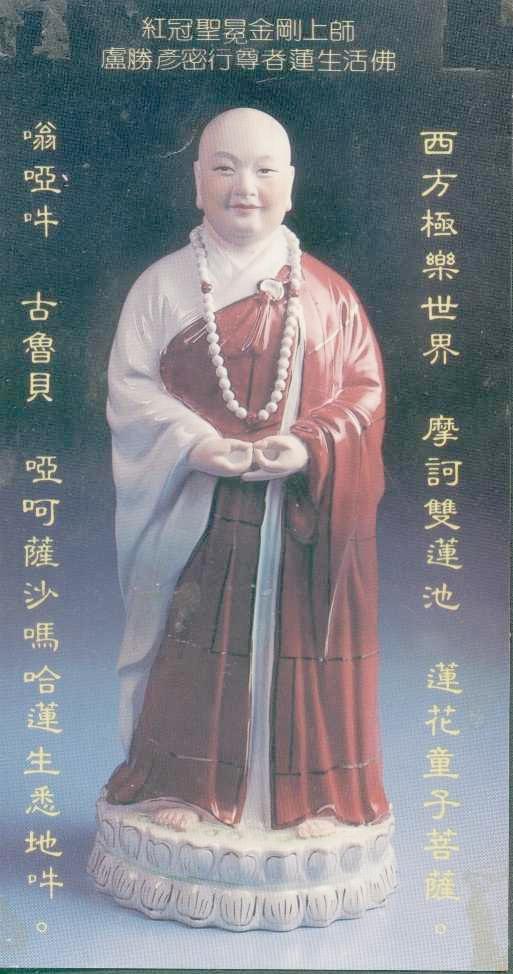
This True Buddha Sutra is the spontaneous revelation from the heart of Living Buddha Lian-sheng, the emanation body of White Mahapadmakumara of the Maha Twin Lotus Ponds in the Western Paradise.

Supplication for the blessing of Living Buddha Lian-sheng:
OM, AH, HUM.

With reverence I make my purified body, speech, and mind an offering to Vairocana. The holy Buddhalocana is the dharma body, Padmakumara is the bliss body, and Living Buddha Lian-sheng is the emanation body; these three bodies being the same in essence as the Buddha`s grace.

Homage to his True Buddha lineage and his transcendent power that encompasses the whole universe. Radiating light throughout the Three Times, he can manifest himself instantaneously. Disciples of Buddha should constantly cry out for his pure light which enhances blessings and wisdom.

In the past, his buddhahood was prophesied by Shakyamuni Buddha and he was entrusted with the mission of salvation by Amitabha Buddha. Maitreya Bodhisattva bestowed upon him the Red Crown and Guru Padmasambhava taught him the Tantra.

We pray you never abandon your vows to liberate us all. Thus, as you embrace and enfold us with protection and care, empower us to quickly attain realization.

Namo Vairocana Buddha.
Namo Buddhalocana.
Namo Padmakumara.
Namo Living Buddha Lian-sheng.

Namo the True Buddha Assembly, all buddhas, bodhisattvas, and mahasattvas everywhere throughout the Three Times.

Recite the Sacred Edict three times:
The Western True Buddha Assembly, the Maha Twin Lotus Ponds, the Eighteen Mahapadmakumaras, the Holy Revered One Robed in White, the Holy Red Crown Vajra Master, the Lord of Secrets of the Realm of Vajra-mantra, the Great Enlightened Founder of Ling Xian True Buddha School: the Eminent Tantric Adept Sheng-yen Lu.

Incense Praise:
The incense is now lit, suffusing the dharma realm, and from afar the scent is inhaled by the True Buddha Assembly. Auspicious are the gathering clouds, as we now request, with sincere and earnest hearts, that all buddhas manifest.

Namo cloud canopy of fragrance, bodhisattvas, mahasattvas (3 times).

Namo True Buddha Assembly, all buddhas, bodhisattvas and mahasattvas (3 times).

Invocation of the Two Buddhas and Eight Bodhisattvas:
Namo Vairocana Buddha of the All-Conquering Palace in the Dharma Realm.
Namo Amitabha Buddha of the Western Paradise.
Namo Mahasattva Avalokitesvara.
Namo Mahasattva Maitreya.
Namo Mahasattva Akasagarbha.
Namo Mahasattva Samantabhadra.
Namo Mahasattva Vajrapani.
Namo Mahasattva Manjusri.
Namo Mahasattva Nivaranaviskambin.
Namo Mahasattva Ksitigarbha.
Namo all bodhisattvas and mahasattvas.

Sutra Opening Verse:
The most supreme profound dharma,
Is rarely encountered in hundreds and thousands of kalpas,
As I receive this transmission and blessing,
I vow to penetrate the true meaning of the Tathagata.

The Sutra of Authentic Dharma that Removes Hindrances and Bestows Good Fortune, spoken by Living Buddha Lian-sheng:

Thus, have I heard. At one time, White Mahapadmakumara was present at the Maha Twin Lotus Ponds, sitting upon the great white lotus dharma throne; surrounding him were seventeen other great lotus blossoms. The Green Lotus radiated green light, the Yellow Lotus yellow light, the Red Lotus red light, the Purple Lotus purple light. Each lotus blossom was mysteriously wonderful, pure, and full of fragrance.

White Padmakumara, silently calling forth his spiritual power, transformed the Maha Twin Lotus Ponds into an extraordinarily splendid place filled with golden light. All the flower buds simultaneously burst into fragrant blossoms. Jade grasses sent forth a wonderful scent. White cranes, peacocks, parrots, saris, kalavinkas, and jivajivas all took on a golden hue, and sang graceful heavenly songs in harmony.
The sky filled with golden light. A pure and wonderful heavenly melody resounded from the sky. Fragrances suffused all realms. Golden sky-abodes, adorned throughout with golden lotuses, radiated splendor. From the sky there showered heavenly flowers.

At that moment, the ground shook violently in the Maha Twin Lotus Ponds and throughout countless heavens tremors could be felt. Buddhas, bodhisattvas, and sound-hearers all felt it as well and came to the Maha Twin Lotus Ponds, as did the rulers of all the Thirty-three Heavens. The assembly included beings from the Twenty-eight Heavens, Lords Indra and Brahma, the eight classes of supernatural beings, and the fourfold assembly, all of whom came to hear the revelation of quintessential teaching.

At that moment, the Golden Padmakumara emitted the Great Wisdom Light. The White Padmakumara emitted the Dharma Realm Light. The Green Padmakumara emitted the Ten Thousand Treasure Light. The Black Padmakumara emitted the Subjugation Light. The Red Padmakumara emitted the Vow Light. The Purple Padmakumara emitted the Majestic Light. The Blue Padmakumara emitted the Virtuous Fruition Light. The Yellow Padmakumara emitted the Fortune Fulfilling Light. The Orange Padmakumara emitted the Child Innocence Light.

Upon seeing this, all the heavenly beings were greatly awed. Then Indra arose from his seat and, joining his palms to White Padmakumara, said, `This is most rare, O Holy and Revered One. By what cause does the Maha Twin Lotus Ponds emit such great light and splendor?`

White Mahapadmakumara said, `I will expound upon this for everyone present.` Indra said, `The Holy Revered One is the most mighty and powerful. Please explain to everyone present, that all men and devas may know where to turn.`

At that moment, White Mahapadmakumara addressed Indra and the assembly as follows: `Very well, very well. I will now explain to you and all the beings of the last period of this Buddha-kalpa, and all those in the future who have an affinity with the sutra, so that all may know the True Buddha Tantra and the principle that removes hindrances and bestows good fortune.`

White Mahapadmakumara then said, `All buddhas and bodhisattvas have, in order to liberate living beings, manifested the worlds known as `All-Conquering,`Wonderful Treasure,``Round Pearl,``Sorrowless,``Pure Rest,``Dharma Thought,``Full Moon,``Profound Joy,``Profound Completeness,``Lotus,``Immutable,`and `Omnipresence.`Now, there shall be the `True Buddha World.``

Thus, the buddhas, bodhisattvas, sound-hearers, solitary-buddhas, and all the heavenly beings witnessed the Holy Revered One bringing forth the True Buddha World, understanding it to be a manifestation of the cause and fruition of great compassion of the auspicious well-departed ones of the past, present, and future, and realizing that the Holy Revered One came for the sake of all beings. All present were moved by joy as never before. Then, bowing their heads, they made praise with these verses:

The Holy Revered One of great compassion,
The Secret One who is most supreme,
Had attained enlightenment in the past,
And transcended all worldly passions.
He now establishes the True Buddha World,
Showering compassion on all living beings.
Transforming himself into a pure land founding buddha,
He descends into the saha world.
With Lian-sheng as his name,
He announces and proclaims the dharma to all.
We all now have heard,
And shall vow to protect and uphold his dharma.

At that moment, the holy revered White Mahapadmakumara instructed the assembly, saying `In cultivation, the key to realizing the Buddha Jewel Sambodhi is a quiescent mind; that of realizing the Dharma Jewel is purity of body, speech, and mind; that of realizing the Sangha Jewel is refuge in a True Buddha Guru.`

The Holy Revered One further instructed the assembly, saying `If good men or women, on the eighteenth day of the fifth month of each lunar year, make ablution, abstain from meat, and wear new and clean clothes, or on the eighteenth day of each lunar month, or on their own birthdays, call upon the Two Buddhas and Eight Bodhisattvas before the shrine, and reverently recite this Sutra of Authentic Dharma that Removes Hindrances and Bestows Good Fortune, then their supplications will be answered. Moreover, if incense, flowers, lamps, tea and fruit are offered, along with sincere prayer, then all wishes will be granted.`

The Holy Revered One told the assembly, `People of this saha world, be they high officials, nobility, renunciates, householders, yogis, or common folk, who, upon learning of this sutra, uphold, recite, print and propagate it, shall prosper above all others, have greater lifespan, obtain either a son or daughter as sought, and be blessed with measureless fortune. This is indeed a great fortune-bestowing sutra for obtaining blessings.

One may have ancestors, enemies, close ones or creditors who are unable to obtain liberation and remain lost in the nether world. However, by upholding, reciting, printing, and propagating this sutra, the deceased will ascend to heaven, enemies will be turned away, and those living will be blessed. If there be a man or woman seized by negative forces or afflicted by spirits, or confused and haunted by nightmares, then, by upholding, reciting, printing, and propagating this sutra, all negative influences shall be banished, thereby restoring peace and ease.

If one suffers the physical retribution of illness and calamity, whether due to non-virtuous body karma from previous lives or to the afflictions of spirits, then, by upholding, reciting, printing and propagating this sutra, ill omens will immediately disappear and the causes of illness will quickly be removed. If one suffers from misfortune, legal entanglements or imprisonment, then, by upholding, reciting, printing and propagating this sutra, all such obstacles will dissolve immediately, and calamities will be vanquished and turned into auspiciousness.

Should nations enter into war, then whoever upholds this sutra and enthrones the image of Padmakumara, setting up offerings before it, immediately receives extra prowess wherein no battle can be lost. Those who uphold, recite, print, or propagate this sutra will receive all blessings, just as they desire. All hindrances will be removed, and the sufferings of the cycle of birth and death will be extinguished.`
Then, in the Western True Buddha Assembly at the Maha Twin Lotus Ponds, White Mahapadmakumara proclaimed this mantra:

`Om, gu-ru, lian-sheng sid-dhi, hum.`

When the Holy Revered One completed this discourse, Indra and the whole assembly, including devas, nagas, the rest of the eight classes of supernatural beings, and the fourfold assembly, all paid reverence. They brought forth faith and upheld the teaching.

Thus ends The Sutra of Authentic Dharma that Removes Hindrances and Bestows Good Fortune.

Sūtra of Mahā-Prajñā-Pāramitā Pronounced by Mañjuśrī Bodhisattva

文殊師利所說摩訶般若波羅蜜經
Translated from Sanskrit into Chinese in the Southern Liang Dynasty
by
The Tripiṭaka Master Mandra from Funan

Fascicle 1 (of 2)

Thus I have heard:
At one time the Buddha was staying in the Anāthapiṇḍika Garden of Jetavana Park in the city kingdom of Śrāvastī, together with 1,000 great bhikṣus and 10,000 Bodhisattva-Mahāsattvas. These great Bodhisattvas are all majestically adorned [with merit and wisdom] and standing on the Ground of No Regress. Among them were Maitreya Bodhisattva, Mañjuśrī Bodhisattva, Unimpeded Eloquence Bodhisattva, and Never Abandoning the Mission Bodhisattva.

Bodhisattva-Mahāsattva Mañjuśrī the Youth came at dawn from his place to the place where the Buddha was and stood outside. Then great voice-hearers, such as the venerable Śāriputra, Pūrṇa-Maitrāyaṇīputra, Mahāmaudgalyāyana, Mahākāśyapa, Mahākātyāyana, and Mahākauṣṭhila, also came from their respective places to the place where the Buddha was and stood outside.

The Buddha knew that the assembly had convened. The Tathāgata came out of His dwelling, arranged His seat, and sat down. He asked Śāriputra, “Why are you standing outside this morning?”

Śāriputra replied to the Buddha, “World-Honored One, Bodhisattva Mañjuśrī the Youth arrived first and stood outside the door. I actually arrived later.”

Then the World-Honored One asked Mañjuśrī, “You were the first to arrive here. Did you wish to see the Tathāgata?”

Mañjuśrī replied to the Buddha, “Indeed, World-Honored One, I did come here to see the Tathāgata. Why? I delight in making the right observation to benefit sentient beings. I observe the Tathāgata by the appearances of true suchness: never changing, never moving, never acting, with neither birth nor death, neither existent nor nonexistent, neither somewhere nor nowhere, neither in the past, present, or future, nor not in the past, present, or future, neither dual nor non-dual, neither pure nor impure. Through appearances such as these, I correctly observe the Tathāgata to benefit sentient beings.”

The Buddha told Mañjuśrī, “If one can see the Tathāgata as such, one’s mind will neither grasp nor not grasp, neither accumulate nor not accumulate.”

Śāriputra said to Mañjuśrī, “It is rare for anyone to see the Tathāgata in the way you describe. As you observe the Tathāgata for the sake of all sentient beings, your mind does not grasp sentient beings’ appearances. As you teach all sentient beings to head for nirvāṇa, [your mind] does not grasp the appearance of nirvāṇa. As you manifest such great majesty for all sentient beings, your mind does not see the appearance of majesty.”

Then Bodhisattva-Mahāsattva Mañjuśrī the Youth said to Śāriputra, “Indeed, indeed, it is just as you say. Although I activate the mind of great majesty for all sentient beings, I never see sentient beings’ appearances. Although I am adorned with great majesty for all sentient beings, their realm neither increases nor decreases. Suppose a Buddha stays in a world for a kalpa or over a kalpa. Just as the Buddha is in a one-Buddha world, there are as many Buddhas as the innumerable, boundless sands of the Ganges. Suppose they all pronounce the Dharma day and night for a kalpa or over a kalpa, never resting their minds. Suppose each of them delivers as many sentient beings as the innumerable sands of the Ganges, enabling them to enter nirvāṇa. Yet the realm of sentient beings neither increases nor decreases. This applies to all Buddha Lands in the ten directions. All Buddhas pronounce the Dharma to teach and transform sentient beings, each delivering as many sentient beings as the innumerable sands of the Ganges, enabling them to enter nirvāṇa. Yet the realm of sentient beings neither increases nor decreases. Why not? The definite appearances of sentient beings can never be captured. Hence, the realm of sentient beings neither increases nor decreases.”

Śāriputra then asked Mañjuśrī, “Given that the realm of sentient beings neither increases nor decreases, why do Bodhisattvas always pronounce the Dharma to sentient beings as they seek anuttara-samyak-saṁbodhi?”

Mañjuśrī replied, “Because sentient beings’ appearances are empty, there are neither Bodhisattvas seeking anuttara-samyak-saṁbodhi nor sentient beings to whom they pronounce the Dharma. Why not? I say that, in all dharmas, not a single dharma can be captured.”

The Buddha asked Mañjuśrī, “If sentient beings do not truly exist, why do you speak of sentient beings and their realm?”

Mañjuśrī replied, “The appearance of the realm of sentient beings is just like that of the realm of Buddhas.”
“Is there a measure for the realm of sentient beings?”
“The measure for the realm of sentient beings is just like that for the realm of Buddhas,” he replied.

The Buddha next asked, “Is there a location for the measure of the realm of sentient beings?”
He replied, “The measure of the realm of sentient beings is inconceivable.”
The Buddha next asked, “Does the appearance of the realm of sentient beings abide [in something]?”
He replied, “Open sky does not abide, nor do sentient beings.”
The Buddha asked Mañjuśrī, “If one cultivates prajñā-pāramitā in this way, how does one abide in prajñā-pāramitā?”
Mañjuśrī replied, “Not abiding in dharmas is abiding in prajñā-pāramitā.”
The Buddha next asked Mañjuśrī, “Why is not abiding in dharmas called abiding in prajñā-pāramitā?”
Mañjuśrī replied, “Not abiding in appearances is abiding in prajñā-pāramitā.”
The Buddha next asked Mañjuśrī, “As one abides in prajñā-pāramitā in this way, do one’s roots of goodness increase or decrease?”
Mañjuśrī replied, “As one abides in prajñā-pāramitā in this way, one’s roots of goodness neither increase nor decrease, all dharmas neither increase nor decrease, and the nature and appearance of prajñā-pāramitā neither increase nor decrease. World-Honored One, cultivating prajñā-pāramitā in this way, one neither abandons the dharma of ordinary beings nor grasps the dharma of sages and holy beings. Why not? In [cultivating] prajñā-pāramitā, one does not see any dharma that can be grasped or abandoned. Moreover, cultivating prajñā-pāramitā in this way, one sees neither saṁsāra to dislike nor nirvāṇa to like. Why not? One does not even see saṁsāra, much less dislike it. One does not even see nirvāṇa, much less like it. Cultivating prajñā-pāramitā in this way, one sees neither afflictions to abandon nor merits to grasp. One’s mind neither increases nor decreases with respect to all dharmas. Why not? One sees neither increase nor decrease in the dharma realm.

“World-Honored One, training in this way is called cultivating prajñā-pāramitā. World-Honored One, seeing neither birth nor death of dharmas is cultivating prajñā-pāramitā. World-Honored One, seeing neither increase nor decrease of dharmas is cultivating prajñā-pāramitā. World-Honored One, wishing for nothing and seeing no dharma-appearance to seek for are cultivating prajñā-pāramitā. World-Honored One, one sees nothing beautiful or ugly, high or low, to grasp or abandon. Why? Dharmas are neither beautiful nor ugly because they are free from appearances. Dharmas are neither high nor low because they are equal in dharma nature. Dharmas are beyond being grasped or abandoned because they abide in true reality. This is the way to cultivate prajñā-pāramitā.”

The Buddha asked Mañjuśrī, “Is the Buddha Dharma not superb?”
Mañjuśrī replied, “I do not see any superb appearance in dharmas. It can be verified, as through the Tathāgata’s self-realization, that all dharmas are empty.”
The Buddha told Mañjuśrī, “Indeed! Indeed! The Tathāgata has attained the perfect enlightenment through self-realization of the emptiness of dharmas.”
Mañjuśrī responded to the Buddha, “World-Honored One, in the dharma of emptiness, is there superbness that can be captured?”
The Buddha said, “Very good! Very good! Mañjuśrī, what you say is the true Dharma!”

The Buddha next asked Mañjuśrī, “Is anuttara called the Buddha Dharma?”
Mañjuśrī replied, “As the Buddha says, anuttara is called the Buddha Dharma. Why? That no dharma can be captured is called anuttara.”

Mañjuśrī continued, “One who cultivates prajñā-pāramitā in this way is not called a Dharma vessel [which is intended to capture things]. Not seeing dharmas that can transform ordinary beings, not seeing the Buddha Dharma, and not seeing enhancing dharmas, are cultivating prajñā-pāramitā. Furthermore, World-Honored One, while cultivating prajñā-pāramitā, one does not see any dharma that can be differentiated or contemplated.”

The Buddha asked Mañjuśrī, “Do you not contemplate the Buddha Dharma?”
Mañjuśrī replied, “No, World-Honored One, in my contemplation, I do not see the Buddha Dharma. Nor do I differentiate dharmas into ordinary beings, voice-hearers, and Pratyekabuddhas. Hence it is called the unsurpassed Buddha Dharma. Moreover, as one cultivates prajñā-pāramitā, seeing neither the appearances of ordinary beings nor the appearances of the Buddha Dharma, nor the definite appearances of dharmas, is cultivating prajñā-pāramitā. While cultivating prajñā-pāramitā, one does not see the desire realm, the form realm, the formless realm, or the nirvāṇa realm. Why not? Not seeing dharmas with the appearance of extinction is cultivating prajñā-pāramitā. While cultivating prajñā-pāramitā, one sees neither the one giving kindness nor the other requiting kindness. Contemplating the appearances of subject and object without differentiation is cultivating prajñā-pāramitā. As one cultivates prajñā-pāramitā, seeing neither the Buddha Dharma to grasp nor the dharma of ordinary beings to abandon is cultivating prajñā-pāramitā. As one cultivates prajñā-pāramitā, seeing neither the dharma of ordinary beings to terminate nor the Buddha Dharma to realize, yet still coming to its realization, is cultivating prajñā-pāramitā.”

The Buddha praised Mañjuśrī, “Very good! Very good! You can describe so well the appearances of the profound prajñā-pāramitā, which is the Dharma Seal that Bodhisattva-Mahāsattvas are learning. Even voice-hearers, of whom some are still learning and others have nothing more to learn, and Pratyekabuddhas should train for their bodhi fruit without separating from this Dharma Seal.”

The Buddha told Mañjuśrī, “If those who have heard this Dharma are not shocked or terrified, they must have already planted their roots of goodness not just under thousands of Buddhas, but even under billions of koṭis of Buddhas. Then they are able not to be shocked or terrified by this profound prajñā-pāramitā.”

Mañjuśrī said to the Buddha, “I now will further explain the meaning of prajñā-pāramitā.”
The Buddha said, “Speak, then.”
[Mañjuśrī said] “World-Honored One, while cultivating prajñā-pāramitā, one should not see whether one should abide in a dharma, nor should one see whether an object has an appearance that can be grasped or abandoned. Why not? Tathāgatas do not see dharmas as appearances of objects. They do not even see the states of Buddhas, not to mention the states of voice-hearers, Pratyekabuddhas, or ordinary beings. One should not grasp appearances, whether conceivable or inconceivable. By not seeing various dharma appearances, one will realize, on one’s own, the inconceivable dharma of emptiness. All Bodhisattvas who train in this way must have made offerings to innumerable billions of koṭis of Buddhas, under whom [they must have] planted their roots of goodness. Consequently, they are able not to be shocked or terrified by this profound prajñā-pāramitā. Moreover, as one cultivates prajñā-pāramitā, seeing neither bondage nor liberation, nor distinctions among ordinary beings or even among the Three Vehicles, is cultivating prajñā-pāramitā.”

The Buddha asked Mañjuśrī, “To how many Buddhas have you made offerings?”
Mañjuśrī replied, “Buddhas and I have illusory appearances, which are neither recipients nor givers.”
The Buddha asked Mañjuśrī, “Can you not now abide in the Buddha Vehicle?”
Mañjuśrī replied, “I do not see a single dharma in my contemplation. How should I abide in the Buddha Vehicle?”
The Buddha asked, “Mañjuśrī, have you not acquired the Buddha Vehicle?”
Mañjuśrī replied, “The Buddha Vehicle is only a name, which can be neither captured nor seen. How can I acquire it?”
The Buddha asked, “Mañjuśrī, have you acquired the unimpeded wisdom-knowledge?”
Mañjuśrī replied, “I am the unimpeded. How can the unimpeded acquire the unimpeded?”
The Buddha asked, “Do you sit in a bodhimaṇḍa?”
Mañjuśrī replied, “None of the Tathāgatas sits in a bodhimaṇḍa. How should I alone sit in a bodhimaṇḍa? I presently see that dharmas abide in true reality.”
The Buddha asked, “What is called true reality?”
Mañjuśrī replied, “The view that one has a self1 is true reality.”
The Buddha asked, “Why is the view that one has a self true reality?”
Mañjuśrī replied, “Taking this view as an appearance of true suchness, which is neither real nor unreal, neither coming nor going, with neither a self nor no self, is called true reality.”

Śāriputra said to the Buddha, “World-Honored One, those who can come to a definite understanding of this meaning are called Bodhisattvas. Why? Because they have learned the appearances of such profound prajñā-pāramitā, and their minds are not shocked, not terrified, not baffled, and not regretful.”

Maitreya Bodhisattva said to the Buddha, “World-Honored One, those who have learned all the dharma appearances of prajñā-pāramitā are near a Buddha’s seat. Why? Tathāgatas are presently aware of these dharma appearances.”

Mañjuśrī Bodhisattva said to the Buddha, “World-Honored One, if those who have heard this profound prajñā-pāramitā can be not shocked, not terrified, not baffled, and not regretful, we should know that they in effect see Buddhas.”

Then the upāsikā No Appearance said to the Buddha, “World-Honored One, dharmas, such as ordinary beings, voice-hearers, Pratyekabuddhas, Bodhisattvas, and Buddhas, have no appearances. Therefore, upon hearing prajñā-pāramitā, we are not astonished, not terrified, not baffled, and not regretful. Why not? Dharmas have never had any appearances.”

The Buddha told Śāriputra, “If good men or good women, having heard such profound prajñā-pāramitā, can come to resoluteness in their minds, not shocked, not terrified, not baffled, and not regretful, know that they stand on the Ground of No Regress. If those who have heard this profound prajñā-pāramitā are not shocked, not terrified, not baffled, and not regretful, but believe, accept, appreciate, and listen tirelessly, they have in effect fulfilled dāna-pāramitā, śīla-pāramitā, kṣānti-pāramitā, vīrya-pāramitā, dhyāna-pāramitā, and prajñā-pāramitā. Moreover, they can reveal and explicate [the teachings] to others and can have them train accordingly.”

The Buddha asked Mañjuśrī, “In your opinion, what is meant by attaining anuttara-samyak-saṁbodhi and by abiding in anuttara-samyak-saṁbodhi?”
Mañjuśrī replied, “I have no anuttara-samyak-saṁbodhi to attain, nor do I abide in the Buddha Vehicle. Then how should I attain anuttara-samyak-saṁbodhi? What I describe is only the appearance of bodhi.”
The Buddha praised Mañjuśrī, “Very good! Very good! You have so skillfully explained the meaning of this profound Dharma. You have long planted your roots of goodness under past Buddhas, training with purity in the Brahma way of life according to the dharma of no appearance.”
Mañjuśrī replied, “If one sees appearances, then one can speak of no appearance. I now see neither appearance nor no appearance. How can I be said to train in the Brahma way of life according to the dharma of no appearance?”

The Buddha asked Mañjuśrī, “Do you see voice-hearers’ precepts?”
“Yes, I see them.”
The Buddha asked, “How do you see them?”
Mañjuśrī replied, “I do not hold the view of ordinary beings, the view of holy beings, the view of those who are still learning, or the view of those who have nothing more to learn. Nor do I hold the great view, the small view, the view to overcome, or the view not to overcome. I hold neither a view nor its opposite view.”

Śāriputra said to Mañjuśrī, “This is how you view the Voice-Hearer Vehicle. How do you view the Buddha Vehicle?”
Mañjuśrī said, “I do not see the dharma of bodhi. Nor do I see anyone training for bodhi or attaining bodhi.”
Śāriputra asked Mañjuśrī, “What is called Buddha? How does one observe a Buddha?”
Mañjuśrī asked, “What is self?”
Śāriputra replied, “Self is only a name, and the appearance of a name is empty.”
Mañjuśrī said, “Indeed! Indeed! Just as self is only a name, so too Buddha is only a name. Realizing the emptiness of a name is bodhi. One should seek bodhi without using names. The appearance of bodhi is free from words. Why? Words and bodhi are both empty.

“Furthermore, Śāriputra, you ask me what is called Buddha and how one should observe a Buddha. That which has neither birth nor death, neither names nor appearances, and is neither coming nor going, is called Buddha. As one observes the true reality of one’s own body, in the same way one observes a Buddha. Only the wise can understand that this is called observing a Buddha.”

Then Śāriputra said to the Buddha, “World-Honored One, prajñā-pāramitā as pronounced by Mañjuśrī is not understandable or knowable to novice Bodhisattvas.”

Mañjuśrī said, “Not only novice Bodhisattvas are unable to know it, but even riders of the Two Vehicles who have accomplished their undertaking [for Arhatship or Pratyekabuddhahood] are unable to understand and know it. No one can know the Dharma expounded in this way. Why not? The appearance of bodhi cannot be known through such dharmas as seeing, hearing, capturing, thinking, speaking, or listening. Bodhi is empty and silent in nature and appearance, with no birth, no death, no attaining, no knowing, no shape, and no form. How can there be an attainer of bodhi?”

Śāriputra asked Mañjuśrī, “Has not the Buddha, in the dharma realm, attained anuttara-samyak-saṁbodhi?”
Mañjuśrī replied, “No, Śāriputra. Why not? The World-Honored One is the dharma realm. Verifying the dharma realm by means of the dharma realm would be a contradiction. Śāriputra, the appearance of the dharma realm is bodhi. Why? In the dharma realm, sentient beings have no appearances because all dharmas are empty. The emptiness of all dharmas is bodhi, which is non-dual and free from differentiation. Śāriputra, without differentiation, there is no knower. Without a knower, there are no words. Without words, there is neither existence nor nonexistence, neither knowing nor not knowing. This is true for all dharmas. Why? Dharmas cannot be identified by locations, which imply a definite nature. For example, the sinful appearance of the [five] rebellious acts is inconceivable. Why? Because the true reality of dharmas is indestructible. Thus, the sin of committing a rebellious act has no self-essence. True reality is neither reborn in heaven nor fallen into hell, nor does it enter nirvāṇa. Why not? All karmic conditions abide in true reality, which is neither coming nor going, neither cause nor effect. Why? The dharma realm has no edge, neither front nor back. Therefore, Śāriputra, [in true reality] pure spiritual trainees do not enter nirvāṇa, and bhikṣus with grave sins do not fall into hell. They are neither worthy nor unworthy of offerings, neither ending nor not ending their afflictions. Why not? All dharmas abide in equality [in emptiness].”

Śāriputra asked, “What is called the unwavering Endurance in the Realization of the No Birth of Dharmas?”
Mañjuśrī replied, “Not seeing the appearance of birth or death in even a speck of dharma is called the unwavering Endurance in the Realization of the No Birth of Dharmas.”

Śāriputra asked, “Who is called a bhikṣu who does not overcome?”
Mañjuśrī replied, “An Arhat, who has no more afflictions to discharge, is the one who does not overcome. Why? All his afflictions have been eradicated and, with nothing to overcome, he is called the one who does not overcome. Those who take fallible mental actions are called ordinary beings. Why? Ordinary beings do not act in accord with the dharma realm and, therefore, are called the fallible ones.”

Śāriputra said, “Very good! Very good! You now have well explained to me the meaning of an Arhat, who has ended his afflictions and the discharges thereof.”
Mañjuśrī said, “Indeed! Indeed! I am a true Arhat, who has ended his afflictions. Why? I have crushed the desire for the Voice-Hearer Vehicle and the desire for the Pratyekabuddha Vehicle. For this reason, I am called an Arhat, who has ended his afflictions.”

The Buddha asked Mañjuśrī, “When a Bodhisattva sits in a bodhimaṇḍa, does he attain anuttara-samyak-saṁbodhi?”
Mañjuśrī replied, “When a Bodhisattva sits in a bodhimaṇḍa, he does not attain anuttara-samyak-saṁbodhi. Why not? The appearance of bodhi is true suchness. Not finding a speck of dharma to capture is called anuttara-samyak-saṁbodhi. Because bodhi has no appearance, who can sit and who can rise? For this reason, I see neither a Bodhisattva sitting in a bodhimaṇḍa nor anyone realizing anuttara-samyak-saṁbodhi.”

Mañjuśrī said to the Buddha, “World-Honored One, bodhi is the five rebellious acts, and the five rebellious acts [in true reality] are bodhi. Why? Bodhi and the five rebellious acts [in true reality] are free from duality because there is neither learning nor learner, neither perceiving nor perceiver, neither knowing nor knower, neither differentiating nor differentiator. These appearances are called bodhi. In the same way one should view the appearances of the five rebellious acts. If there are those who say that they see bodhi and have attained it, we should know that they are the ones with exceeding arrogance.”

The World-Honored One asked Mañjuśrī, “Would you say that I am the Thus-Come One, and address me as the Tathāgata?”
Mañjuśrī responded, “No, World-Honored One, I would not say that [the name] Tathāgata is the Thus-Come One. Suchness does not have an appearance that can be called suchness. Nor is there Tathāgata wisdom that can know suchness. Why not? The Tathāgata and His wisdom are free from duality. Because emptiness is Tathāgata, which is only a name, what should I say is the Tathāgata?”

The Buddha asked Mañjuśrī, “Do you doubt the Tathāgata?”
Mañjuśrī replied, “No, World-Honored One, I have no doubt because, in my observation, the Tathāgata, with neither birth nor death, does not have a definite nature.”

The Buddha asked Mañjuśrī, “Would you say that the Tathāgata has appeared in the world?”
Mañjuśrī replied, “If the Tathāgata appeared in the world, the entire dharma realm would also appear.”

The Buddha asked Mañjuśrī, “Would you say that Buddhas as numerous as the sands of the Ganges have entered parinirvāṇa?”
Mañjuśrī replied, “Buddhas have the one appearance, the inconceivable appearance.”

The Buddha agreed with Mañjuśrī, “Indeed! Indeed! Buddhas have the one appearance, the inconceivable appearance.”
Mañjuśrī asked the Buddha, “World-Honored One, is the Buddha now staying in this world?”
The Buddha answered Mañjuśrī, “Indeed! Indeed!”

Mañjuśrī said, “If the Buddha were staying in this world, then Buddhas as numerous as the sands of the Ganges would also stay in their worlds. Why? All Buddhas have the same one appearance, the inconceivable appearance. The inconceivable appearance has neither birth nor death. If future Buddhas were to appear in their worlds, then all Buddhas [of the past, present, and future] would also appear in their worlds. Why? In what is inconceivable, there is no appearance of past, future, or present. However, sentient beings are attached to their perceptions, and they say that there are Buddhas who appear in the world and Buddhas who enter nirvāṇa.”

The Buddha told Mañjuśrī, “This is the understanding of Tathāgatas, Arhats, and Bodhisattvas at the level of avinivartanīya. Why? These three types of beings, having heard the profound Dharma, are able neither to criticize nor to praise it.”

Mañjuśrī agreed with the Buddha, “World-Honored One, who could criticize and who could praise the inconceivable Dharma?”
The Buddha told Mañjuśrī, “Tathāgatas are inconceivable, and ordinary beings are inconceivable.”

Mañjuśrī asked the Buddha, “Are ordinary beings also inconceivable?”
The Buddha replied, “They too are inconceivable. Why? All mental appearances are inconceivable.”

Mañjuśrī said, “If you say that Tathāgatas are inconceivable and that ordinary beings are also inconceivable, then innumerable Buddhas are just fatiguing themselves seeking nirvāṇa. Why? Inconceivable dharmas are nirvāṇa, with no difference.”

Mañjuśrī said, “Such inconceivability of ordinary beings and of Buddhas can be understood only by good men and good women who have long developed roots of goodness and stayed near beneficent learned friends.”

The Buddha asked Mañjuśrī, “Do you want the Tathāgata to be the superb one among sentient beings?”
Mañjuśrī replied, “I want the Tathāgata to be the foremost among sentient beings. However, sentient beings’ appearances cannot be captured”

The Buddha asked, “Do you want the Tathāgata to acquire the inconceivable Dharma?”
Mañjuśrī replied, “I want the Tathāgata to acquire the inconceivable Dharma without [taking it as] a dharma of accomplishment.”

The Buddha asked Mañjuśrī, “Do you want the Tathāgata to expound the Dharma and to teach and transform sentient beings?”
Mañjuśrī replied to the Buddha, “I want the Tathāgata to expound the Dharma and to teach and transform sentient beings. Yet neither the speaker nor the listener can be captured. Why not? Because they abide in the dharma realm. Sentient beings in the dharma realm have no differentiated appearances.”

The Buddha asked Mañjuśrī, “Do you want the Tathāgata to be the unexcelled fortune field?”
Mañjuśrī replied, “The Tathāgata, with the appearance of endlessness, is the endless fortune field. The appearance of endlessness is the unexcelled fortune field. Because [the Tathāgata] is neither a fortune field nor a non-fortune field, He is called the fortune field. Because He has no appearances, such as light or dark, birth or death, He is called the fortune field. If one can understand the appearances of the fortune field in this way, the seeds of goodness one plants deeply will neither increase nor decrease.”

The Buddha asked Mañjuśrī, “Why do the planted seeds neither increase nor decrease?”
Mañjuśrī replied, “The appearances of the fortune field are inconceivable. Cultivating goodness in the field in accordance with the Dharma is also inconceivable. Planting seeds in this way is called no increase and no decrease, and it is also the unexcelled, superb fortune field.”

Then, by virtue of the Buddha’s spiritual power, the great earth quaked in six ways, manifesting the appearances of impermanence. Sixteen thousand people achieved the Endurance in the Realization of the No Birth of Dharmas. Moreover, 700 bhikṣus, 3,000 upāsakas, 40,000 upāsikās, and 60 koṭi nayuta gods of the six desire heavens, in the midst of dharmas, discarded their defilements and acquired the pure Dharma-eye.

Fascicle 2 (of 2)

At that time Ānanda rose from his seat, bared his right shoulder, and knelt on his right knee. He asked the Buddha, “World-Honored One, why did this great earth quake in six ways?”
The Buddha answered Ānanda, “It displayed this auspicious sign because I said that the fortune field had no differentiated appearances. When past Buddhas pronounced in this place the appearances of the fortune field to benefit sentient beings, the entire world also quaked in six ways.”

Śāriputra said to the Buddha, “World-Honored One, Mañjuśrī is inconceivable. Why? Because the dharma appearances he has explained are inconceivable.”

The Buddha praised Mañjuśrī, “Indeed! Indeed! Just as Śāriputra says, what you have said is truly inconceivable.”

Mañjuśrī said to the Buddha, “World-Honored One, the inconceivable is ineffable, and the conceivable is also ineffable. Conceivable and inconceivable natures are both ineffable. All appearances of sound are neither conceivable nor inconceivable.”

The Buddha asked, “You have entered the inconceivable samādhi?”
Mañjuśrī replied, “No, World-Honored One, I am the inconceivable. Not seeing a mind that can conceive, how can I be said to enter the inconceivable samādhi? When I first activated the bodhi mind, I resolved to enter this samādhi. Now I think that I have entered this samādhi without any mental appearances. To learn archery, a student has to practice for a long time to acquire the skill. Because of his longtime practice, he now shoots without using his mind, and all his arrows hit the target. I have trained in the same way. When I started learning the inconceivable samādhi, I had to focus my mind on one object. After practicing for a long time, I have come to accomplishment. I now am constantly in this samādhi without thinking.”

Śāriputra asked Mañjuśrī, “Is there a silent samādhi that is more wonderful?”
Mañjuśrī replied, “If there were actually an inconceivable samādhi, you could then ask for a silent samādhi. According to my understanding, even the inconceivable samādhi cannot be captured, so how can you ask for a silent samādhi?”

Śāriputra asked, “The inconceivable samādhi cannot be attained?”
Mañjuśrī replied, “The conceivable samādhi has an attainable appearance while the inconceivable samādhi has an unattainable appearance. All sentient beings have attained the inconceivable samādhi. Why? It is called the inconceivable samādhi because all mental appearances are not the [true] mind. Therefore, the [mental] appearances of all sentient beings and the appearance of the inconceivable samādhi are the same, not different.”

The Buddha praised Mañjuśrī, “Very good! Very good! You have long planted your roots of goodness under Buddhas and trained with purity in the Brahma way of life. So you are able to expound such a profound samādhi. Are you now settled in prajñā-pāramitā?”
Mañjuśrī said, “If I could say that I abide in prajñā-pāramitā, this would be a perception founded on the view that one has a self. Abiding in a perception founded on the view that one has a self means that prajñā-pāramitā has a location. That I do not abide in prajñā-pāramitā is also [a perception] founded on the view that one has a self, and is a location as well. Free from these two locations [subject and object], I abide in non-abiding, like Buddhas abiding in the inconceivable state of peace and silence. Such an inconceivable state is called the dwelling of prajñā-pāramitā. In the dwelling of prajñā-pāramitā, all dharmas have neither appearance nor act.

“Prajñā-pāramitā is inconceivable. The inconceivable state is the dharma realm, which has no appearance. Having no appearance is the inconceivable state; the inconceivable state is prajñā-pāramitā. Prajñā-pāramitā and the dharma realm are the same, not distinct. Having neither differentiation nor appearance is the dharma realm; the dharma realm is the realm of prajñā-pāramitā. The realm of prajñā-pāramitā is the inconceivable state; the inconceivable state is the realm of no birth and no death.”

Mañjuśrī continued, “The realm of a Tathāgata and the realm of self are the appearance of non-duality. Those who cultivate prajñā-pāramitā in this way do not seek bodhi. Why not? Bodhi, which is free from appearances, is prajñā-pāramitā.

“World-Honored One, to know the appearances of self means not to be captivated by it. Not knowing and not being captivated by anything is what Buddhas know. The inconceivable [state of] not knowing and not being captivated by anything is what Buddhas know. Why? They know that the true nature of everything has no appearance. Then what drives the dharma realm? What in its true nature has neither self-essence nor attachment is called no thing2 and is free from location, dependency, and fixity. Freedom from location, dependency, and fixity means having neither birth nor death; having neither birth nor death is the virtue of any saṁskṛta or asaṁskṛta dharma. With this knowledge, one will not elicit perception. Without perception, how can one know the virtue of any saṁskṛta or asaṁskṛta dharma? Not knowing3 is the inconceivable state. The inconceivable state is what Buddhas know, such as neither grasping nor not grasping, seeing neither the appearance of past, present, or future, nor the appearance of coming or going, and grasping neither birth nor death, neither cessation nor perpetuity, neither arising nor acting. This knowledge is called the true wisdom-knowledge, the inconceivable wisdom-knowledge. Like the open sky, with neither appearances nor features, in unequaled equality, it makes no comparison, neither this against that nor good against evil.”

The Buddha told Mañjuśrī, “This knowledge is called the wisdom-knowledge that never fades.”

Mañjuśrī said, “The wisdom-knowledge of no act is also called the wisdom-knowledge that never fades, but it is like gold ore, which has to be processed in order to know whether it is good or bad. If gold is not refined, there is no way to know [its quality]. The same is true for the appearance of the wisdom-knowledge that never fades. One needs to go through the experience in not thinking, not being captivated, not arising, and not acting. When one’s mind is completely quiet, neither rising nor falling, then it will be revealed.”

Then the Buddha said to Mañjuśrī, “When Tathāgatas speak of their own wisdom-knowledge, who can believe it?”

Mañjuśrī said, “Such wisdom-knowledge is neither the dharma of nirvāṇa nor the dharma of saṁsāra. It is the way of silence and the way of stillness, neither annihilating greed, anger, and delusion, nor not annihilating them. Why? [Wisdom-knowledge] is endless and indestructible, neither apart from saṁsāra nor together with it. It is acquired through neither training nor not training for bodhi. This understanding is called the right belief.”

The Buddha praised Mañjuśrī, “Very good! Very good! What you say is a profound understanding of its meaning.”

Then Mahākāśyapa asked the Buddha, “World-Honored One, if such profound true Dharma is pronounced in future times, who will be able to believe, understand, and accept it, and to practice it accordingly?”
The Buddha replied to Mahākāśyapa, “If bhikṣus, bhikṣuṇīs, upāsakas, and upāsikās who have heard this sūtra in this assembly hear this Dharma in future times, they definitely will believe and understand it. They will be able to read and recite this [sūtra of] profound prajñā-pāramitā, to accept and uphold it, and to expound it to others. As an analogy, an elder who has lost his precious jewel feels sad and distressed. If he retrieves it later, he will be very joyous. Therefore, Kāśyapa, likewise will be the bhikṣus, bhikṣuṇīs, upāsakas, and upāsikās in this assembly. They have the mind of faith and delight. If they do not hear the Dharma, they will feel distressed. If they come to hear it, they will, with great joy, believe and understand it, accept and uphold it, and always delight in reading and reciting it. Know that these people in effect see Buddhas and that they in effect serve and make offerings to Buddhas.”

The Buddha told Mahākāśyapa, “As an analogy, when gods in Trayastriṁśa Heaven see the buds of the celestial pārijāta tree emerge, they are elated. They know that this tree’s buds will soon open into full bloom. Likewise, if, among bhikṣus, bhikṣuṇīs, upāsakas, and upāsikās, there are those who can believe and understand the prajñā-pāramitā they have heard, they too will soon bring the entire Buddha Dharma to bloom. If in future times, among bhikṣus, bhikṣuṇīs, upāsakas, and upāsikās, there are those who, after hearing this prajñā-pāramitā, can believe and accept it, and read and recite it, without regret or bafflement, know that they have already heard and accepted this sūtra in this assembly. They will also be able to pronounce and circulate it widely to the public in towns and cities. Know that they will be protected and remembered by Buddhas. If, among good men and good women, there are those who can believe and delight in this profound prajñā-pāramitā without doubts, they must have long trained and learned under past Buddhas, and planted their roots of goodness.

“As an analogy, a man stringing beads with his hands suddenly comes across an unexcelled genuine jewel. His heart is filled with great joy. Know that this person must have seen [such a jewel before]. Therefore, Kāśyapa, when good men or good women who are learning other dharmas suddenly come across the profound prajñā-pāramitā, if they rejoice in the same way, know that they must have heard it before. Suppose there are sentient beings that, after hearing the profound prajñā-pāramitā, can believe and accept it with great joy in their hearts. They too must have served innumerable Buddhas, from whom they must have heard prajñā-pāramitā, which they must have studied and cultivated.

“As an analogy, a person has passed and seen a city or a town. Later on, he hears others praise how lovely in this city are the gardens, ponds, fountains, flowers, fruits, and trees, as well as the male and female residents, and he is very happy to hear these things. He even asks them to describe this city with its gardens, beautiful decorations, various flowers, ponds and fountains, an abundance of sweet fruits, various kinds of wonders, and all the lovely things. After hearing these descriptions again, this person will be even happier. Those who react in the same way as this person must have seen it before. If, among good men and good women, there are those who, upon hearing prajñā-pāramitā, are able to listen and accept it with faith, to feel joy, to delight in hearing it tirelessly, and even to ask for repetitions, know that they have already heard prajñā-pāramitā from Mañjuśrī.”

Mahākāśyapa said to the Buddha, “World-Honored One, if in future times, among good men and good women, there are those who, having heard this profound prajñā-pāramitā, listen and accept it with faith and delight, we should know by this indication that they too have heard it from past Buddhas, and have studied and cultivated it.”

Mañjuśrī said to the Buddha, “World-Honored One, the Buddha says that dharmas have neither appearance nor act and are inherently in nirvāṇa. If good men or good women can truly understand this meaning and pronounce it as heard, they will be praised by Tathāgatas. Their statement, consistent with dharma appearances, in effect is the pronouncement of Buddhas. It is called the glowing appearance of prajñā-pāramitā, also called the glowing totality of the Buddha Dharma, and it reveals true reality in an inconceivable way.”

The Buddha told Mañjuśrī, “When I was walking the Bodhisattva Way, I developed my roots of goodness. Those who aspire to stand on the Ground of Avinivartanīya should learn prajñā-pāramitā. Those who aspire to attain anuttara-samyak-saṁbodhi should learn prajñā-pāramitā. If good men and good women aspire to understand all dharma appearances and to know the equality in sentient beings’ mental realm, they should learn prajñā-pāramitā. Mañjuśrī, those who aspire to learn the entire Buddha Dharma without obstructions should learn prajñā-pāramitā. Those who aspire to understand, upon Buddhas’ attainment of anuttara-samyak-saṁbodhi, their sublime appearance, majestic deportment, and innumerable Dharma procedures should learn prajñā-pāramitā. Those who aspire to know, before Buddhas’ attainment of anuttara-samyak-saṁbodhi, their appearance, deportment, and Dharma procedures should also learn prajñā-pāramitā. Why? In the dharma of emptiness, one does not perceive Buddhas, bodhi, and so forth. If, among good men and good women, there are those who aspire to know such appearances without doubts, they should learn prajñā-pāramitā. Why? In [cultivating] prajñā-pāramitā, one does not see dharmas as born or dead, pure or impure. Therefore, good men and good women should learn prajñā-pāramitā in this way. Those who aspire to know that all dharmas have no such appearance as past, present, or future should learn prajñā-pāramitā. Why? In nature and appearance, the dharma realm does not have past, present, or future. Those who aspire to know, without hindrances in their minds, that all dharmas constitute the dharma realm should learn prajñā-pāramitā. Those who aspire to hear the three turnings of the Dharma wheel in the twelve appearances, and to know them through self-realization, without grasping them or being captivated by them, should learn prajñā-pāramitā. Those who aspire to invoke the mind of lovingkindness for sheltering all sentient beings everywhere without a limit, without thinking of sentient beings’ appearances, should learn prajñā-pāramitā. Those who aspire neither to dispute with sentient beings nor to grasp the appearance of no dispute should learn prajñā-pāramitā. Those who aspire to know a Buddha’s Ten Powers, such as knowing right or wrong in any situation, to know His Four Fearlessnesses, to abide in His wisdom-knowledge, and to acquire unimpeded eloquence, should learn prajñā-pāramitā.”

Mañjuśrī said to the Buddha, “World-Honored One, I correctly observe dharmas and find them to be asaṁskṛta, with no appearance, no attainment, no benefit, no birth, no death, no coming, no going, no knower, no perceiver, and no doer. I see neither prajñā-pāramitā nor the state of prajñā-pāramitā, neither realization nor no realization. I make no differentiation, nor any ludicrous statement. All dharmas are endless, apart from ending. There is no dharma of ordinary beings, no dharma of voice-hearers, no dharma of Pratyekabuddhas, and no dharma of Buddhas. There is neither attainment nor no attainment, neither saṁsāra to abandon nor nirvāṇa to realize, neither the conceivable nor the inconceivable, neither act nor no act. Such are dharma appearances! Then how does one learn prajñā-pāramitā?”

The Buddha told Mañjuśrī, “Knowing such dharma appearances is called learning prajñā-pāramitā. If Bodhisattva-Mahāsattvas aspire to learn the Samādhi of Bodhi Command because, after learning it, they can illuminate the entire profound Buddha Dharma, know the names of all Buddhas, and understand their worlds, without obstructions, they should learn prajñā-pāramitā as explained by Mañjuśrī.”

Mañjuśrī asked the Buddha, “Why is it called prajñā-pāramitā?”
The Buddha replied, “Prajñā-pāramitā is boundless, limitless, nameless, and with neither appearance nor conception. Like the dharma realm, which has no divisions or limits, it has neither refuge nor no [safe] island, neither merit nor demerit, neither light nor dark. It is called prajñā-pāramitā, also called the action field of Bodhisattva-Mahāsattvas. Being neither the action field nor the no-action field, in the One Vehicle, it is called the no-action field. Why? It is the field of neither perception nor action.”

Mañjuśrī asked the Buddha, “World-Honored One, what actions can one take to attain anuttara-samyak-saṁbodhi quickly?”
The Buddha replied, “Mañjuśrī, those who cultivate prajñā-pāramitā as explained will quickly attain anuttara-samyak-saṁbodhi. Furthermore, there is the Samādhi of the One Action. If good men or good women train in this samādhi, they will also quickly attain anuttara-samyak-saṁbodhi.”

Mañjuśrī asked, “World-Honored One, what is called the One Action Samādhi?”
The Buddha replied, “The dharma realm has only one appearance. Focusing one’s mind on the dharma realm is called the One Action Samādhi. If, among good men and good women, there are those who aspire to enter the One Action Samādhi, they should first hear prajñā-pāramitā and next train and learn it accordingly. Then they will be able to enter the One Action Samādhi, which fits the conditions of the dharma realm—indestructible, inconceivable, with no regress, no hindrance, and no appearance. If good men or good women aspire to enter the One Action Samādhi, they should sit properly in an open place, facing the direction of a Buddha, abandon distracting thoughts and appearances, focus their minds on that Buddha, and keep saying His name. If they can continue, thought after thought, thinking of one Buddha, they will be able to see, in their thinking, past, future, and present Buddhas. Why? The merit acquired from thinking of one Buddha is immeasurable and boundless, no different from the merit acquired from thinking of innumerable Buddhas or thinking of the inconceivable Buddha Dharma. They all will realize true suchness and attain the perfect enlightenment, acquiring immeasurable merit and eloquence. Those who enter the One Action Samādhi in this way will know that there are no differentiated appearances in the dharma realm of Buddhas, who are as numerous as the sands of the Ganges. Although among the voice-hearers, Ānanda is the foremost in the Buddha Dharma he has heard, in his total retention of memory, and in his eloquence and wisdom, but his attainment has a measure and a limit. If one has attained the One Action Samādhi, one will be able to differentiate one by one the Dharma Doors in the sūtras and to know them all, without obstructions. One will be able to expound them day and night unceasingly with wisdom and eloquence. By comparison, Ānanda’s eloquence and hearing much [of the Dharma] are not even one hundred-thousandth thereof. Bodhisattva-Mahāsattvas should think this thought: ‘How should I acquire this One Action Samādhi, which will bring inconceivable merit and innumerable [good] names?’”

The Buddha continued, “Bodhisattva-Mahāsattvas should always think of the One Action Samādhi and assiduously make energetic progress, never negligent or indolent. Through step-by-step gradual training and learning, they will enter the One Action Samādhi, as evidenced by their inconceivable merit. However, those who malign the true Dharma or disbelieve that hindrances are caused by evil karmas will not be able to enter it.

“Moreover, Mañjuśrī, as an analogy, a person has acquired a precious bead, and he shows it to the jeweler. The jeweler says that it is a priceless genuine jewel. He then asks the jeweler, ‘Polish it for me. Do not let it lose its luster and color.’ After the jeweler has polished it, this precious bead becomes brilliant and transparent throughout. Mañjuśrī, if good men or good women train in the One Action Samādhi in order to acquire inconceivable merit and innumerable [good] names, in the course of their training, they will know dharma appearances with clear understanding, without obstructions. Their merit will grow in the same way. Mañjuśrī, using the sun as an example, its light is pervasive and not diminishing. Likewise, if one attains the One Action Samādhi, one will acquire all merits without any shortfall, like the sunlight illuminating the Buddha Dharma. Mañjuśrī, the Dharma I have pronounced is all in the one flavor apart from flavors, which is the flavor of liberation, the flavor of silence and stillness. If good men and good women have attained this One Action Samādhi, what they expound will also be in the one flavor apart from flavors, which is the flavor of liberation, the flavor of silence and stillness, completely in accordance with the true Dharma, without error or mistake. Mañjuśrī, Bodhisattva-Mahāsattvas who have attained this One Action Samādhi will all fulfill the [Thirty-Seven] Elements of Bodhi and quickly attain anuttara-samyak-saṁbodhi.

“Furthermore, Mañjuśrī, Bodhisattva-Mahāsattvas who see in the dharma realm neither differentiated appearances nor the one appearance will quickly attain the inconceivable anuttara-samyak-saṁbodhi. Those who know that in bodhi there is no attainment of Buddhahood will quickly attain anuttara-samyak-saṁbodhi. Those who can endure, without shock, fear, or doubt, their belief that all dharmas are the Buddha Dharma will quickly attain anuttara-samyak-saṁbodhi.”

Mañjuśrī asked the Buddha, “World-Honored One, can one quickly attain anuttara-samyak-saṁbodhi through such causes?”

The Buddha replied, “Anuttara-samyak-saṁbodhi is attained through neither causes nor no causes. Why? The inconceivable state is realized through neither causes nor no causes. If good men and good women who have heard these words do not become negligent or indolent, know that they have already planted their roots of goodness under past Buddhas. Therefore, if bhikṣus and bhikṣuṇīs who have heard this profound prajñā-pāramitā are not shocked or terrified, they have truly renounced family life to follow the Buddha. If upāsakas and upāsikās who have heard this profound prajñā-pāramitā are not shocked or terrified, they have truly taken refuge [in the Buddha].

“Mañjuśrī, good men or good women who do not study the profound prajñā-pāramitā are not training by means of the Buddha Vehicle. Taking the great earth as an example, all medicinal plants must grow from the earth. Mañjuśrī, likewise the roots of goodness of Bodhisattva-Mahāsattvas must depend on prajñā-pāramitā to develop, so that their attainment of anuttara-samyak-saṁbodhi will have no obstructions.”

Mañjuśrī asked the Buddha, “World-Honored One, in Jambudvīpa’s cities and towns, where should we pronounce such profound prajñā-pāramitā?”

The Buddha told Mañjuśrī, “Suppose those who have heard prajñā-pāramitā in this assembly vow that in future lives they will always respond to prajñā-pāramitā in order to strengthen their faith and understanding, and that they will be able to hear this sūtra again. Know that those people did not come with small roots of goodness because they are capable of accepting and appreciating what they hear. Mañjuśrī, if there are those who have heard prajñā-pāramitā from you, they should say this: ‘In prajñā-pāramitā, there is no dharma of voice-hearers, no dharma of Pratyekabuddhas, no dharma of Bodhisattvas, and no dharma of Buddhas. Nor is there the dharma of ordinary beings or the dharma of saṁsāra.’”

Mañjuśrī said to the Buddha, “World-Honored One, if bhikṣus, bhikṣuṇīs, upāsakas, or upāsikās ask me, ‘How does the Tathāgata pronounce prajñā-pāramitā?’ I should reply, ‘Given that dharmas do not have the appearance of dispute, how should the Tathāgata pronounce prajñā-pāramitā? He does not see dharmas to dispute over, nor does he see that the minds and consciousnesses of sentient beings can know [dharmas].’

“Moreover, World-Honored One, I should also pronounce the ultimate reality. Why? All dharma appearances equally abide in true reality. Arhatship is not a particularly superb dharma. Why not? The dharma of Arhats and the dharma of ordinary beings are neither the same nor different. Furthermore, World-Honored One, according to the Dharma explained in this way, no sentient being has already realized nirvāṇa, is realizing it, or will realize it. Why not? Sentient beings do not have definite appearances.”

Mañjuśrī continued, “If there are those who wish to hear prajñā-pāramitā. I will tell them that listeners do not think of, hear, or capture anything, nor are they captivated by anything, just like a magically conjured person who never differentiates. This statement is a true teaching of the Dharma. Therefore, listeners should not construct dual appearances [subject and object]. They should train in the Buddha Dharma without abandoning other views, and they should neither grasp the Buddha Dharma nor abandon the dharma of ordinary beings. Why? Buddhas and ordinary beings as two dharmas have empty appearances, beyond grasping or abandoning. When someone asks me, I give these answers, thus comforting him and setting him [on the right path]. Good men and good women should ask such questions and abide in this way with their minds not regressing or baffled. They should speak of dharma appearances in accord with prajñā-pāramitā.”

Then the World-Honored One praised Mañjuśrī, “Very good! Very good! Just as you say, if good men and good women wish to see Buddhas, they should learn prajñā-pāramitā. If they wish to serve Buddhas and to make offerings to them in accordance with the Dharma, they should learn prajñā-pāramitā. If they wish to say that the Tathāgata is the World-Honored One to them, they should learn prajñā-pāramitā. Even if they wish to say that the Tathāgata is not the World-Honored One to them, they should learn prajñā-pāramitā. If they wish to attain anuttara-samyak-saṁbodhi, they should learn prajñā-pāramitā. Even if they do not wish to attain anuttara-samyak-saṁbodhi, they should learn prajñā-pāramitā. If they wish to attain all samādhis, they should learn prajñā-pāramitā. Even if they do not wish to attain all samādhis, they should learn prajñā-pāramitā. Why? Because the Samādhi of No Act has no varied appearances and because dharmas have neither birth nor death. If there are those who wish to know that all dharmas are false names, they should learn prajñā-pāramitā. If those who wish to know, with their minds not regressing or baffled, that all sentient beings that train in the Bodhi Way do not seek the appearance of bodhi, they should learn prajñā-pāramitā. Why? Because all dharmas are the appearance of bodhi. If there are those who wish, with their minds not regressing or baffled, to know the appearances of sentient beings’ actions and no actions, and to know that having no action is bodhi, that bodhi is the dharma realm, and that the dharma realm is true reality, they should learn prajñā-pāramitā. If there are those who wish to know that all Tathāgatas’ transcendental powers and magical displays have neither appearances nor obstructions, nor locations, they should learn prajñā-pāramitā.”

The Buddha told Mañjuśrī, “If bhikṣus, bhikṣuṇīs, upāsakas, and upāsikās do not wish to go down the evil life-paths, they should learn a four-verse stanza on prajñā-pāramitā, accept and uphold it, read and recite it, and explain it to others in accord with true reality. Know that these good men and good women will definitely attain anuttara-samyak-saṁbodhi and reside in Buddha Lands. If there are those who, upon hearing this prajñā-pāramitā, are not shocked or terrified, but elicit faith and understanding from their minds, know that they are sanctified by Buddhas with a seal, the Mahāyāna Dharma Seal held only by Buddhas. If good men or good women learn this Dharma Seal, they will transcend not only the evil life-journeys but also the paths of voice-hearers and Pratyekabuddhas.”

At that time the god-king of the Thirty-three Heavens, as an offering to prajñā-pāramitā, the Tathāgata, and Mañjuśrī, brought wonderful celestial flowers of utpala, kumuda, puṇḍarīka, and māndarāva, as well as celestial sandalwood incense, powdered incense, various kinds of golden jewelry, and celestial music. After showering such offerings over them, he said, “I wish always to learn the Prajñā-Pāramitā Dharma Seal.”

The god-king Śakro-Devānām-Indra then made this vow: “I pray that the good men and good women in Jambudvīpa can always hear this sūtra, the definitive Buddha Dharma, and that they will believe and understand it, accept and uphold it, read and recite it, and expound it to others. Let all the gods protect and support them.”

At that time the Buddha told Śakro-Devānām-Indra, “Kauśika, indeed, indeed, these good men and good women will definitely attain Buddha bodhi.”

Mañjuśrī said to the Buddha, “World-Honored One, good men and good women who accept and uphold [this sūtra] in this way will acquire great benefits and immeasurable merit.”

Then, by virtue of the Buddha’s spiritual power, the entire great earth quaked in six ways. The Buddha smiled as He emitted great radiance, illuminating everywhere in the Three-Thousand Large Thousandfold World. Mañjuśrī said to the Buddha, “World-Honored One, this is the appearance of the Tathāgata’s sealing of prajñā-pāramitā.”

The Buddha said, “Mañjuśrī, indeed, indeed. This auspicious sign always appears after prajñā-pāramitā is pronounced. It is for sealing prajñā-pāramitā and for enabling people to accept and uphold it, not to praise or criticize it. Why? The appearance-free Dharma Seal is beyond praise or criticism. I now, with this Dharma Seal, keep celestial māras from finding any opportunity [to make trouble].”

After the Buddha finished these words, great Bodhisattvas and the four groups of disciples, having heard the explanation of prajñā-pāramitā, greatly rejoiced. They all believed in, accepted, and reverently carried out the teachings.

—Sūtra of Mahā-Prajñā-Pāramitā Pronounced by Mañjuśrī Bodhisattva
Translated from the digital Chinese Canon (T08n0232)