高王觀世音真經 + 七佛滅罪真言
Relics ("se-li-ce" in mandarin) from an old man who chanted The High King Avalokitasvara Sutra everyday for 15 years!
Grand Master Lu Sheng Yen Dharma Talk About The Power of The High KIng Avalokitasvara Sutra
Wednesday, April 20, 2011

SERIVĀṆIJA - JĀTAKA (Vol. 1 book 3)
"If in this faith." This lesson too was taught by the Blessed One while at Sāvatthi, also about a Brother who gave up persevering.
For, when the man was brought by the Brethren exactly as in the foregoing case, the Master said, "You, Brother, who after devoting yourself to this glorious doctrine which bestows Path and Fruit, are giving up persevering, will suffer long, like the hawker of Seri who lost a golden bowl worth a hundred thousand pieces."
The Brethren asked the Blessed One to explain this to them. The Blessed One made clear a thing concealed from them by re-birth.
____________________________
Once on a time in the kingdom of Seri, five aeons ago, the Bodhisatta dealt in pots and pans, and was called 'the Serivan.' In the company of another dealer in the same wares, a greedy fellow who was also known as 'the Serivan,' he came across the river Telavāha and entered the city of Andhapura. Apportioning the streets between the two of them, he set about hawking his wares round the streets of his district, and the other did the same in his district.
Now in that city there was a decayed family. Once they had been rich merchants, but by the time of our story they had lost all the sons and brothers and all their wealth. The sole survivors were a girl and her grandmother, and they got their living by working for hire. Nevertheless, they had got in their house the golden bowl out of which in the old days the great merchant, the head of the family, used to eat; but it had been thrown among the pots and pans, and having been long out of use, was grimed over with dirt, so that the two women did not know that it was gold. To the door of their house came the greedy hawker on his round, crying, "Waterpots to sell! Waterpots to sell!" And the damsel, when she knew be was there, said to her grandmother, "Oh, do buy me a trinket, grandmother."
"We're very poor, dear; what can we offer in exchange for it?" "Why here's this bowl which is no good to us. Let us change that for it."
The old woman had the hawker brought in and seated, and gave him the bowl, saying, "Take this, sir, and be so good as to give your sister something or other in exchange."
The hawker took the bowl in his hand, turned it over, and, suspecting it was gold, scratched a line on the back of it with a needle, whereby he knew for certain that it was real gold. Then, thinking that he would get the pot without giving anything whatever for it to the women, he cried, "What's the value of this, pray? Why it isn't worth half a farthing!" [112] And therewithal he threw the bowl on the ground, rose up from his seat, and left the house. Now, as it had been agreed between the two hawkers that the one might try the streets which the other had already been into, the Bodhisatta came into that same street and appeared at the door of the house, crying, "Waterpots to sell!" Once again the damsel made the same request of her grandmother; and the old woman, replied, "My dear, the first hawker threw our bowl on the ground and flung out of the house. What have we got left to offer now?"
"Oh, but that hawker was a harsh-spoken man, grandmother dear; whilst this one looks a nice man and speaks kindly. Very likely he would take it." "Call him in then." So he came into the house, and they gave him a seat and put the bowl into his hands. Seeing that the bowl was gold, he said, "Mother, this howl is worth a hundred thousand pieces; I haven't its value with me."
"Sir, the first hawker who came here said that it was not worth half a farthing; so he threw it to the ground and went away. It must have been the efficacy of your own goodness which has turned the bowl into gold. Take it; give us something or other for it; and go your way." At the time the Bodhisatta had 500 pieces of money and a stock worth as much more. The whole of this he gave to them, saying, "Let me retain my scales, my bag, and eight pieces of money." And with their consent he took these with him, and departed with all speed to the river-side where he gave his eight coins to the boatman and jumped into the boat. Subsequently that greedy hawker had come back to the house, and had asked them to bring out their bowl, saying he would give them something or other for it. But the old woman flew out at him with these words, "You made out that our golden bowl which is worth a hundred thousand pieces was not worth even a half-farthing. But there came an upright hawker (your master, I take it), who gave us a thousand pieces for it and took the bowl away."
Hereupon he exclaimed, "He has robbed me of a golden bowl worth a full hundred thousand pieces; he has caused me a terrible loss." And intense sorrow came upon him, so that he lost command over himself and became like one distraught. [113] His money and goods he flung away at the door of the house; he threw off his upper and under cloths; and, armed with the beam of his scales as a club, he tracked the Bodhisatta down to the river-side. Finding the latter already crossing, he shouted to the boatman to put back, but the Bodhisatta told him not to do so. As the other stood there gazing and gazing at the retreating Bodhisatta, intense sorrow seized upon him, His heart grew hot; blood gushed from his lips; and his heart cracked like the mud at the bottom of a tank, which the sun has dried up. Through the hatred which he had contracted against the Bodhisatta, he perished then and there. (This was the first time Devadatta conceived a grudge against the Bodhisatta.) The Bodhisatta, after a life spent in charity and other good works, passed away to fare according to his deserts.
_____________________________
When the Supreme Buddha had ended this lesson, he, the All-Knowing One himself, uttered this stanza:--
If in this faith you prove remiss, and fail
To win the goal whereto its teachings lead,
Then, like the hawker called 'the Serivan,'
Full long you'll rue the prize your folly lost.
After having thus delivered his discourse in such a way as to lead up to Arahatship, the Master expounded the Four Truths, at the close whereof the fainthearted Brother was established in that highest Fruit of all, which is Arahatship.
And, after telling the two stories, the Master made the connexion linking them both together, and identified the Birth by saying in conclusion, "In those days Devadatta was the foolish hawker; and I myself was the wise and good hawker."
Source:
http://www.sacred-texts.com/bud/j1/j1006.htm
The Jataka
Jataka, (Pali and Sanskrit: “Birth”) any of the extremely popular stories of former lives of the Buddha, which are preserved in all branches of Buddhism. Some Jataka tales are scattered in various sections of the Pali canon of Buddhist writings, including a group of 35 that were collected for didactic purposes. These 35 constitute the last book, the Cariya Pitaka (“Basket of Conduct”), of the Khuddaka Nikaya (“Short Collection”). Beyond this, a Sinhalese commentary of the 5th century that is questionably attributed to a Buddhist scholar named Buddhagosa and called the Jatakatthavannana, or Jatakatthakatha, gathers together about 550 Jataka stories, some of which are quite brief while others are as long as novelettes.
Each tale begins by noting the occasion that prompted its telling and ends with the Buddha identifying the lives of the people in the introductory story with those of people from the past. There is humour in these stories and considerable variety. The future Buddha may appear in them as a king, an outcast, a god, an elephant—but, in whatever form, he exhibits some virtue that the tale thereby inculcates.
Many Jatakas have parallels in the Mahabharata (“Great Epic of the Bharata Dynasty”), the Panca-tantra (animal fables), the Puranas (collections of legends), and elsewhere in non-Buddhist Indian literature. Some turn up again in such places as Aesop’s fables. The Jataka stories have also been illustrated frequently in sculpture and painting throughout the Buddhist world.
Source:
http://www.britannica.com/EBchecked/topic/301580/Jataka
Thursday, April 7, 2011
Hidden Secrets of Tantric Sex

Is the Tantra a sex-obsessed corruption of Buddhism?
Padmavajra thinks not.
The last great phase in the historical development of Indian Buddhism was known as the Vajrayana (literally, 'The Thunderbolt Way) Its major contribution to Buddhism was a number of new and radical practices leading to Enlightenment.
The Vajrayana's aim was to bring the practitioner to Enlightenment as quickly as possible, and one of its central concerns was the liberalization and canalization of more and more of the practitioner's energy. Part of its way of effecting this was through sexual metaphor, sexual symbolism, and even through what have been called 'sexo-yogic' practices.
Because of its apparent use of sex as an aspect of spiritual practice, the Vajrayana has provoked two extreme responses in the West. In the early days of Buddhist studies, the Vajrayana was generally condemned as a corruption of the sublime ideals of Buddhism. More recent interest has tended to the other extreme. Some are attracted to the Vajrayana precisely because of its apparent sanctification of desire in general, and sexual desire in particular. In a recent exposition of the Vajrayana by a Tibetan teacher, we find the following, '...if desire for a woman arises, it must be relied upon...'. Such a presentation of the Vajrayana would seem to suggest that being a Buddhist does not involve changing ourselves. We can, apparently, keep hold of our desires as they will lead us to Enlightenment.
The truth behind the use of sexual themes in the Vajrayana is, as might be expected, far from either of the extremes mentioned. Though we are dealing with a vast and complex subject, it is possible to discern three distinct (though related) aspects of the place of sex in the Vajrayana. Firstly, there is the shock value of sexual language. For example, in the canonical texts of the Vajrayana - the Tantras - which flourished in India roughly between the 4th and 10th centuries CE, we can find sexual intercourse with the chaodali (outcaste girl) and prostitutes being recommended. At that time, contact - what to speak of sexual congress - with an outcaste, according to Hindu society (back to which Buddhism had to some extent been drawn), would have been deemed spiritually polluting. But, in making such recommendations, the Vajrayana was simply trying to shock people out of their mundane social conditioning. It was seeking to liberate the energy locked up in the convention and taboo of Hindu society.
Whether or not these recommendations were enacted is an open question. Stephan Beyer enthusiastically describes the followers of the Vajrayana thus: 'They sang of wisdom as the great Whore, for she opens herself to every man who seeks her, ...made love to the spontaneous maiden within them, and preached a world upside down, ... and were altogether quite outrageous and shocking to all good and sober citizens. It would be interesting to ponder how the Vajrayana would speak to our own age, where sexual license has become a kind of norm. If they wanted to shock people out of their conditioning today, the old followers of the Vajrayana might have to appear as a rap artist advocating the ecstacies etc.
In that passage quoted from Stephan Beyer, we read that the followers of the Vajrayana 'made love to the spontaneous maiden within them'. This brings us to the second aspect of sex in the Vajrayana, the so-called 'sexo-yogic' practices.
We have seen that the Tantras recommended sexual intercourse with the chaodali. Now, as well as aiming to decondition, this sort of recommendation would sometimes also have been referring to certain forms of yogic practice. Here, the word chaodali is not referring to a woman at all. In this context, chaodali can be translated as 'the fiery one' and, simply stated, refers to the vital energy that must be contacted and incorporated into our practice. It parallels the better known kundalini.
The practices associated with the arousal of the chaodali occur in the anuttara-yoga Tantra, the highest level of Vajrayana practice, and - traditionally - should be undertaken only after years of successful training in Hinayana, Mahayana, and lower Vajrayana disciplines. Indeed, in India and old Tibet, these practices would not have been known about, even in theory, by those not initiated into them. (This might be one of the reasons why these practices were 'hidden away in sexual language - to keep them out of the reach of those not ready to undertake them.) Sangharakshita has recalled that in his own contact with Tibetan monks, lamas, and lay people, there was no special interest shown in these teachings, and definitely no unhealthy emphasis.
There also seems to be some doubt as to whether the 'sexo-yogic' practices were intended to describe anything physical at all. Herbert Guenther, a writer normally very sure of himself, says in commenting on one of these practices: 'We move in a world which probably is neither physical nor mental, but may partake of both (or be something completely different). In some of the practices found in the Tantras and their related works we encounter elaborate visualization techniques where the practitioner is instructed to see himself as a Buddha in sexual union with a female consort, usually described as a dakini. Here the aspect of sexo-yogic practice merges with the third aspect, that of sexual symbolism.
Within the Mahayana, Enlightenment was principally seen as the insoluble union of wisdom and compassion. Mahayana artists were fond of depicting this union in paintings and images, in the form of the androgynous figure of the Bodhisattva - a beautiful sixteen-year-old: gentle, yet strong in appearance.
The Vajrayana sought to depict this union even more vividly, and so depicted the Buddha or Bodhisattva in sexual union with the dakini. We often come across such figures in Vajrayana art. The Buddha or Bodhisattva looks serene, contemplative, blissful; while the dakini - appearing like a goddess - embraces him tightly, and looks rapturously into his face. Here the male figure symbolizes Compassion, the female figure Wisdom. Sangharakshita has commented on such depictions thus: 'One must observe that though there are two figures there are not two persons: there is only one Enlightened person, one Enlightened mind, within which are united reason and emotion, wisdom and compassion.
These representations embody under the form of sexual symbolism (here of course one has nothing to do with sexuality in the ordinary sense) the ideal of Wisdom and Compassion united. Traditionally, these images are considered highly sacred, inspiring profound reverence and devotion, not in any way stimulating a sexual response. However, they have suffered abuse.
Some people go so far as to recommend that during sexual intercourse, the man should visualize himself as the Buddha: the woman should visualize herself as the dakini. Both should experience their lovemaking as an enactment of the uniting of Wisdom with Compassion. Such recommendations provide the deluded with a first class means of rationalizing away their mundane desires.
For most of us, such a practice would be a purely mental activity making no significant difference to the basic urges involved. It would be no more than a fancy way of having sex. For those experienced enough to see and feel themselves to be a Buddha at such times, it is highly unlikely that they would want to involve themselves with sex at all! Being so content, complete, and rich within themselves, they would hardly need to reach beyond themselves for their pleasures.
To conclude, within the Vajrayana, sex - as most of us understand and experience it - is not part of the path to Enlightenment at all. Sexual language within the Vajrayana is strictly metaphorical, strictly symbolic: not to be taken literally. Indeed, if taken literally, some Vajrayana writings will not lead us to Enlightenment, but will sink us more deeply in the mire of greed, hatred, and delusion.
References
1.Thinley Norbu, The Small Golden Key, p.24
2. Stephan Beyer, The Buddhist Experience, p. 258
3. Herbert V. Guenther, The Life' and Teaching of Naropa, pp. 161-162
4. Ven. Sangharakshita, 'Masculinity' and 'Femininity' in the Spiritual Life, p.24
Source:
http://fwbo.org/articles/tantric_sex.html
Wednesday, March 23, 2011
What Is The Essential Meaning Of Human Life?
To encourage ourselves to train in the stages of the path to enlightenment, we should continually recall the three special characteristics of our human life: its freedom and endowment, its rarity, and its great meaning.
Due to the limitations of their body and mind, those who have taken rebirth as animals, for example, have no opportunity to understand or practice the path to liberation. Only humans are free from such hindrances and have all the necessary conditions, known as “endowments”, to engage in spiritual paths, which alone lead to everlasting happiness. This freedom and endowment is the first special characteristic that makes human life so precious.
The second special characteristic of our human life is rarity. Although there are many human in this world each one of us has only 1 life. One person may own many cars and houses, but even riches person in the world cannot possess more than 1 life, and when that is drawing to an end, he or she cannot buy or borrow or manufacture another. When we lose this life, it will be very difficult to find another similarly qualified life in the future. Our human life is therefore very rare.
The third special characteristic of our human life is its great meaning. If we use our human life to accomplish spiritual realizations, our life is immensely meaningful. By using it in this way, we actualize our full potential and progress from the state of an ordinary, deluded being to that of a fully enlightened being, the highest of all beings, and when we have done this we shall have power to benefit all living beings without exception. Thus, by using our human life for spiritual development. We can solve all our problems and fulfill all our own and others wishes. What could be more meaningful than this?
Through contemplating these three characteristics we arrive at the determination:
I will not waste my human life because it is so precious, so rare, and so meaningful. Instead, I will use it in the most beneficial way.
We hold this determination as our object of meditation without forgetting it, and meditate on it single-pointedly for as long as possible.
Having developed this deep desire to make our life meaningful, we then ask ourself, ‘What is the essential meaning of a human life?’ Finding good external conditions cannot be its essential meaning, for even animals can do this. Many animals are very skilled at finding food, protecting their family, destroying their enemies, and so forth, these abilities are not exclusively human.
However, it is only humans who have the opportunity to attain enlightenment for the benefit of all living beings. This is the real meaning of our human life. With this understanding, we can extract the full meaning of our human life by receiving the empowerment and then putting the instructions into practice.
In general, Vajrayana is the actual quick path to enlightenment, but whether or not we attain enlightenment quickly through Vajrayana practice depends upon our faith, motivation, and understanding. However, it is only human who have the opportunity to attain enlightenment for the benefit of all living beings. This is the real meaning of our human life by receiving the empowerment and then putting the instructions into practice.
In general, Vajrayana is the actual quick path to enlightenment, but whether or not we attain enlightenment quickly through Vajrayana practice depends on our faith, motivation and understanding.
By Dr Arthur Tjandra (a diciple of True Buddha School)
Tuesday, March 8, 2011
KURUKULLA Mantra (咕嚕咕列佛母心咒)
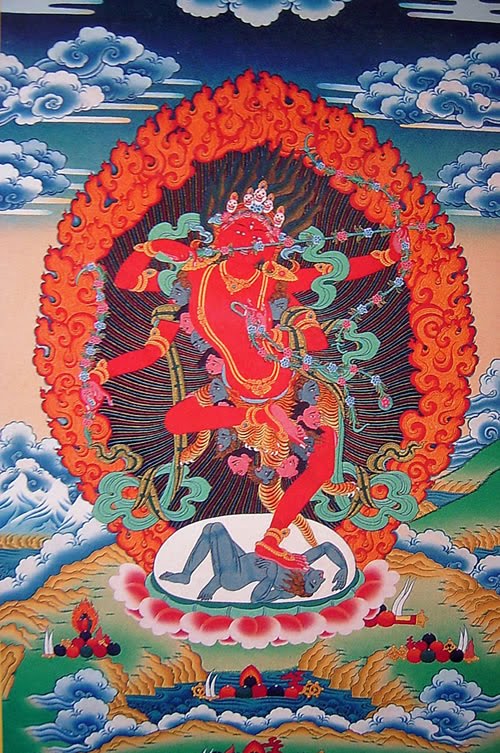

Kurukulle - Deity of Magnetism
(The Dakini of Magic and Enchantments)
Kurukulla is one of the Buddhist goddesses originating from the country of Oddiyana. Kurukulla is translated in Tibetan as Rigiyedma (rig-byed-ma) meaning “ She who is the cause of Knowledge”. She is associated with King Indrabhuti.
She is also sometimes called Red Tara(sgrol-ma dmar-po) or Tarodbhava Kurukulla, ‘The Kurukulla who arises from Tara’.
She is very popular among Tibetans for her magical function of enchantment (dbang gi ‘phrin-las) and bewitching of the people in order to bring them under one’s power (dbang du bsdud). She is pre-eminently the Buddhist goddess of witchcraft and enchantment but in real sense, she represents empowerment of the feminine in a patriarchal milieu.
As Green Tara be invoked for the protection from various dangers and threats, generally the eight great terrors and fears; Kurukulle may be called upon to exercise her powers of enchantment and bewitchment to bring under her power those evil spirits, demon and humans working against the welfare of humanity and spiritual evolution. In Tibet, she also is called upon when commencing the building of new monastery, undertaking new business or enterprise e.t.c. to subdue and subjugate all demonic and human forces that stands in ones’ path.
In Sadhanamala, there occurs list of eight great siddhis or magical powers acquired through her practice:
Khadga-siddhi; power to be invincible in battle with a sword.
Anjana-siddhi; power to remove ordinary lack of sight using a magical ointment
Padalepa-siddhi; power to be swift of foot using magical ointment
Antardhana-siddhi; power to become invisible
Rasayana-siddhi; power to rejuvenation and long-life through obtaining the exilir of life by way of an alchemical process
Khechara-siddhi; power to levitate or to fly through sky
Bhucara-siddhi; power to move through earth, mountains and solid walls
Patala-siddhi; power to have command over the spirit of the underworld
According to the texts, Kurukulla is sixteen years old because sixteen is ideal number signifying perfection. She has beautiful face with voluptuous body and alluring. She is red in color for her magical function of enchantment and magnetism. She is single faced because she embodies non-dual wisdom beyond conventional distinctions of good and evil. She is naked is because she is unconditioned by discursive thoughts.
She has four arms because of four immeasurable states of mind, namely, love, compassion, joy and equanimity. She holds bow and arrow entwined with flowers because she can give rise to thoughts of desire in others minds. On her other hands, she holds hook that attracts and summons them into her presence and noose to bind them to he will. She wears human bone ornaments signifying the five perfections and she herself embodies the sixth perfection of wisdom. She wears a necklace of fifty freshly served human heads as she vanquishes fifty negative emotions. She is seen dancing as she is very energetic and active. Her compassionate activity manifests in both Samsara and Nirvana. She dances treading upon a male human corpse as she enchants and subjugates demon of ego. She stands on red sun disc because her nature is hot and enflamed with passion and she stands upon red lotus blossom because she is pure vision of enlightened awareness.
Subscribe to:
Posts (Atom)

