Tuesday, October 12, 2010

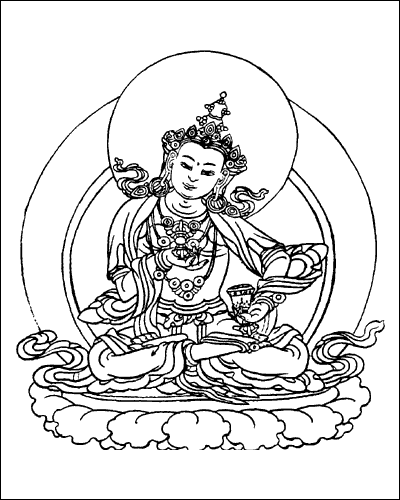
Manjusri, the Gentle Glory Bodhisattva


Buddhism consistently promotes two virtues: Compassion and Wisdom. Avalokitesvara embodies Great Compassion; the last Bodhisattva on the right, Manjusri (Chinese Wen Shu) represents Great Wisdom.

An oft-told example illustrates the relationship of the two virtues of Wisdom and Compassion. Suppose you are approached by a homeless person asking for a handout. You give him some money-which he promptly spends on alcohol. You have been compassionate, but not wise. So the next time you are approached, you give nothing; now you have been wise, but not compassionate. What is the solution? Buy him some food. This is wise and compassionate. Compassion without wisdom is foolish; wisdom without compassion is harsh. As every good parent knows, the two must be used in balance.

Thus Manjusri maintains the balance of Wisdom amongst the Bodhisattvas. His name means "Gentle Glory," a good description of the main benefit of Wisdom. Often (though not here) shown holding a sword, Manjusri cuts through the ignorance of this world. He is also often shown holding sutra scrolls. Here we see him sitting on a lion; the roar of the lion represents the Buddha's teaching spreading through the world. (The Buddha is sometimes called "The Lion of the Shakyas," as his Shakya clan was associated with lions.)

How did Manjusri come to be associated with Wisdom? Simply, he was the teacher of seven successive Buddhas, the Sakyamuni Buddha being the last. One version of his story says that he himself was a Buddha in the distant past, and came back to teach the others. The Buddha said that in fact hundreds of Buddhas of the past became enlightened through Manjusri's teaching.

Central to his instruction was the idea that everything is "void," or "empty," an idea we will discuss further in a moment. When asked if he followed the Mahayana teachings, he replied, "As I see it, everything is void, so there is no such thing as Buddhist teachings. Then, how can there be any Mahayana teaching for me to follow?"

As radical as his teaching was his behavior. All monks in the Buddha's time were required to gather in monasteries for the rainy season. one year, Manjusri failed to show up. It was later discovered that he had spent the three months in the company of children and prostitutes, as well as the maids in the Sravasti Palace. Naturally, the other monks were outraged, none more than the venerable Kasyapa. He demanded that Manjusri be expelled from the assembly. The Buddha then revealed that during that one rainy season, Manjusri taught "five hundred women, five hundred boys and five hundred girls, who will never lose their determination to seek Enlightenment." Kasyapa asked him how he had accomplished such a feat, and Manjusri replied, "I used many methods to teach them. I used games, or I used money, or I applied good deeds, or I showed my magical powers, or I showed the appearances of various deities, or I showed the appearance of a Buddha, or I showed a horrible face, or I appeared in other forms. Why? People are different, so I had to preach to them in many ways."

A final story of Manjusri's power: Once five hundred monks were able to see their pasts, and discovered that they had all killed their own parents or committed other atrocities. They came to doubt that they would ever achieve Enlightenment. Sensing this, the Buddha called on Manjusri to instruct them. Manjusri instantly pulled out his sword and placed it at the Buddha's neck. The monks instantly grasped his point: the mind is illusory. There is no sword, no Buddha, no Manjusri-therefore there were no crimes, no criminals, no victims. With his sword of truth Manjusri cut through the illusion and showed them reality as it really is.

THE PILGRIMAGE
In front of Manjusri Bodhisattva

O Manjusri, Bodhisattva of Great Wisdom!

I ask you to help me gain control over my mind and destroy all unwholesome thoughts.

Through your great wisdom, you have ensured that the Lion's Roar of the Buddha's teaching is heard throughout the world.

Through destroying ignorance you have shown us that we can overcome delusion.

Let me also, by cultivating my mind, attain this excellence.

Help me to conquer ignorance and delusion.

Help me to practice right view and right understanding, learning to see things as they truly are,

that I may dedicate further merit to the enlightenment of all sentient beings.

O great One of the Marvelous Gentle Power, hear my prayer!

O great Manjusri Bodhisattva, hear my prayer!

Source:
http://groups.google.com/group/soc.culture.pakistan.religion/browse_thread/thread/48452253023e66ae
_____________________________________________________________________________________

Manjushri is the eldest of the great Bodhisattvas and is foremost in wisdom.

"Manjushri, a Sanskrit word, is interpreted as 'wonderful virtue' or 'wonderfully auspicious.' Of the Bodhisattvas, Manjushri has the greatest wisdom, and so he is known as 'The Greatly Wise Bodhisattva Manjushri.' Among the Bodhisattvas he holds the highest rank, and so he is listed first, before the Bodhisattva Who Observes the Sounds of the World. There are four great Bodhisattvas: Bodhisattva Manjushri, Bodhisattva Who Observes the Sounds of the World, Bodhisattva Universal Worthy, and Bodhisattva Earth Store.

"Bodhisattva Manjushri dwells in China on Wu-tai Mountain, where his bodhimanda is located. His efficacious responses are marvelous beyond all reckoning. He became a Buddha long ago and was called Buddha of the Race of Honored Dragon Kings. After becoming a Buddha, he 'hid away the great and manifested the small', in order to practice the Bodhisattva way, teach and transform living beings, and help the Buddha [Shakyamuni] propagate the Dharma. His spiritual penetrations and miraculous functions are inconceivable." (DFS II 144-145)

"Bodhisattva Manjushri . . . is a very special Bodhisattva. When he was born, ten kinds of extraordinary events occurred, which show that he was different from other Bodhisattvas. Manjushri is known for his great wisdom.

"'But the Venerable Shariputra is also known for his wisdom,' you may ask. 'What is the difference between the two types of wisdom?'

"The wisdom of Shariputra is provisional wisdom, and the wisdom of Manjushri is real wisdom. The wisdom of Shariputra is the Hinayana wisdom; the wisdom of Manjushri is the Mahayana wisdom.

"What were the ten auspicious signs which manifested at Manjushri's birth?

1) The room was filled with bright light, brighter than the light which could be made by any number of light bulbs. The bright light represented the Bodhisattva's great wisdom.

2) The vessels were filled with sweet dew. Sweet dew is miraculous; drinking it will cure all the sicknesses in the world. Then, instead of having to undergo birth, old age, sickness, and death, you'll only have birth, old age, and death to deal with.

3) The seven jewels came forth from the earth. The seven jewels are gold, silver, lapis lazuli, crystal, mother of pearl, red pearls, and carnelian.

"'Why did the jewels appear?'

"Manjushri had cultivated the Six Perfections and the Ten Thousand Conducts to such a high degree of perfection that in response, wherever he goes, precious gems appear.

4) The gods opened the treasuries. Manjushri Bodhisattva's great spiritual powers caused the earth to open up and expose the many treasuries it contains. This differs from the third, in which the seven jewels well up out of the earth. Here the treasuries were exposed when the earth opened up.

5) Chickens gave birth to phoenixes. Even more unusual than the gods opening the treasuries was the fact that chickens gave birth to phoenixes. Basically, of course, chickens only give birth to chickens. But because Manjushri's birth was such a special occasion, they gave birth to phoenixes.

6) Pigs gave birth to dragons. This is even more unusual than chickens giving birth to phoenixes. . . .

7) Horses gave birth to unicorns. . . .

8) Cows gave birth to white tsai. The white tsai is an extremely rare and auspicious animal. . . . It looks like a horse but it has the hooves of an ox. It is in a special category all of its own.

9) The grain in the granaries turned to gold. Do you think that is strange? Some of you probably think it is so strange that you don't even believe it. If you don't believe it, it's because you don't understand it. If you don't understand it, its no doubt because you've never encountered such a thing before. And so how could you possibly believe it?

"However, the world is a very big place and what we have seen and heard is extremely limited. Therefore, it is not strange that there are unusual phenomena which we have not seen or heard. When the grain turned to gold, it could no longer be used as food, but then just a few grains could be exchanged for a lot of food. . . .

10) Elephants with six tusks appeared. As we know, elephants usually only have two tusks. At the time of Manjushri's birth, however, they appeared with six. Is that strange or not?

"Those ten special signs appeared at the time of Manjushri's birth and represent Manjushri's rare eloquence in speaking all Dharmas. . . .

"When he speaks the Dharma, Manjushri does not discriminate among the dharmas. Although he does not discriminate among the dharmas, he, nevertheless, does not not distinguish all dharmas. The wonder lies right at this point, and that is why he is known as 'wonderful virtue'--Manjushri.

Chinese woodblock print of the Bodhisattva Manjusri from Dunhuang, 10th cent.

"The six tusks stand for the Six Perfections (Six Paramitas) and the elephants stand for the Ten Thousand conducts. . . ." (DFS II 144-149)

What are the 6 Paramitas? please go to this link:
http://www.bhaisajyaguru.com/buddhist-ayurveda-encylopedia/six_paramitas_perfection_mastery_supreme-virtues_completeness_highest-state_crossing-over_bwo-lwo-mi-du.htm
_____________________________________________________________________________________

Manjushri's Mantra to Multiply Prostrations Merit by 1000x:
"Om Namo Manjushriya, Namo Sushriya (Glorious Goodness), Namo Utta-Ma Shriya (Glorious Supreme Sublimity) Svaha"
(Recite 3x)

Manjushri Nama Samgiti
(Chanting the Names of Manjushri):

Om Namo Manjushri Five-Syllables Sutra:
"Om Ah-Ra-Pa-Cha-Na-Dhi (Dhi-Dhi-Dhi-Dhi)"

Manjusri's Rebirth Mantra:
"Om AH Bei La Hum, Kan Cha La, Soha"
Manjushri Nama Samgiti Mantra:
"Om Sarva-Dharma 'bhava-Svabhava-Vishuddha Vajra (Chakshur) A Aa Am Ah. Prakruti-Parishuddhah Sarva-Dharma. Yad Uta Sarva-Tathagata-Jnana-Kaya-Manjushri-Parishuddhitam Upa-dayeti A Aah. Sarva-Tathagata-Hridaya. Hara Hara Om Hum Hrih. Bhagavan-Jnana-Murté. Vagi-Shvara Maha-Pacha. Sarva-Dharma-Gagana-Mala-Supari-Shuddha-Dharma-Dhatu-Jnana-Garbha A Ah".

Source:
http://www.bhaisajyaguru.com/buddhist-ayurveda-encylopedia/manjushri-great-wisdom-bodhisattva_wen-shu-shr-li-pu-sa.htm

Sunday, October 10, 2010

Short Teaching of the Benefit on Doing Smoke Offering


Vajrayana is a part of Mahayana Buddhism which was given by Lord Buddha over 2500 years ago. It contained many special skills that guides practitioner to achieve ultimate happiness along the path of enlightenment. Burn offering is one of the said skill.

Lama Sherab Jungnay recommends the member of Philippine Karma Kagyu Buddhist Society to practice the terma text of burn offering entitled "RIWO SANG CHOE" (translated as "Mountains of Pure Offering") every last Sunday of the month. Lama Sherab told the members that burn offering is one of the parctice of Path of Accumulation and Perfection on Giving Generosity. One prepares great offerings such as five kinds of clothes (white, blue, green, red, and yellow in color) which cut into small pieces, five kinds of beans (black one is not included), cookies, butter, oil, sugar, fruits, rice, some herbal medicine, cypress and pine tree leaves (if available), flowers for altar, some sweets, incense sticks, a tea pot full of tea for offering, and other items that practitioner particularly wishes. The amount of the preparation is based upon one's own ability, same as the space of making fire, environment for one's practice use and so on. Substances of offering are mixed together in one big container. Black tea are to be filled on the offering cup. While the ritual text are recited, offering items are put on small plates for practitioner to thrown it into fire.

This kind of practice is like diamond cutter that helps one to cut through the attachment of materialism. One gathers some charcoals or fire woods with little amount of kerosene to make fire. The said substances of offering are thrown into fire in order to produce smoke that gives sensual pleasures. One offers them to Three Jewels (Buddha, Dharma and Sangha) and Three Roots (Guru, Yidam and Dakinis) to accumulate merits and to invoke blessings. It also make offerings to the Protectors to seek for thier protection either on mundane lives or path of dharma practice. Giving generosity to six kinds of sentient beings who need the blessings of three roots and three jewels. This practice also pay off our debts to those we owe both present and previous life time. Those with form and formless. Those who are harmed unintentionally.
All sentient beings has mind and feelings. They are eager for happiness and wish to be free from sufferings. No matter who they are, human, animals, gods, demi-gods, beings from the three realms, with form or formless, demon or ghost, or beings from hell. All are the same. They all wish for happiness. But due to their negative karma and habitual tendency, they are stocked up here in samsara endlessly. Buddha said they are once our mother in the past. During that time, they are very kind to us. They take care of us all the time. Now they fall into this unfavorable condition, we should do our best to help them. Through the practice of burn offering, we can repay their kindness.


If one can practice Smoke Offering regularly, He might bring benefits to oneself and to all sentient being through the blessings of Three Jewels. His negative karma will be pacified, karmic enemies will be controlled through reconciliation process, hindrances done by demons or evil spirits will be overcome. One's merit, wealth, wisdom and life force will be increased.

Some might comment that why don't we just use the money for buying these offerings and give it to the poor and needies as charity. Lama Sherab Jungnay had explained to the member that in Lord Buddha's 8400 teachings, burn offering and giving generosity are same kind of practice but only different skills. When Lord Buddha gives these teachings, it based on the different capability of sentient beings to understand and practice. Both practices compassion and bodhicitta too. So one must not say "I prefer this one" or "I don't like that one" because both are came from Lord Buddha.

Today, Lama Kunzang, resident lama of Philippine Karma Kagyu Buddhist Society, together with members continue the practice of Riwo Sang Choe Smoke Offering Puja every last Sunday of the month. They Pray for the peacefulness and well-being of everyone. If any one who is interested to join the said puja, please feel free to drop by our dharma center. Lama Kunzang will be very happy to help you.

Source:
http://www.kagyu.org.ph/burn.htm

Saturday, October 9, 2010

100 Deities Jang Chog Prayer


The Origin
It is stated in the Tantric legend that a king once executed his spiritual master. Due to this heavy sin, he passed away immediately and was born in the hell. He experienced the sufferings of all the six realms at the same time. Lord Buddha saw the great suffering of this being and He instructed him on the teaching and practice of the hundred deities. By just listening to this teaching and mantras of the hundred deities, this suffering being was liberated and reborn in heaven.

At one time, there was an evil minister called Shata in Tibet. He had killed many innocent people and also caused a lot of obstacles to prevent the consort of Padmasambhawa, Yeshe Tsogyal, from practicing the Dharma. After his death, he was born in hell. Guru Padmasambhawa, and his consort saw with their wisdom eyes that the former evil minister was experiencing unbearable suffering. His consort tried to save him by using various methods but she did not succeed. Guru Padmasambhawa then used the hundred deities Mandala with Jang Chog to help the evil minister and many beings in the hells. All of them were liberated. Later Guru Padmasambhawa transmitted the teaching of the hundred deities to his twenty-five renowned disciples.

The hundred deities are the attributes and activities of the five Buddhas and their female counterparts. They are the manifestations from the pure nature of our minds, and remain within us in the form of five faculties, five elements and twelve sources of perception and so on. By relying on the practice of the hundred deities or even by just hearing the mantra and seeing the mandala and picture of the hundred deities, one may either instantly or gradually realizes that the nature of one’s mind is inseparable from the perfect wisdom of the hundred deities.

The Puja and Its Benefits
During the performance of Jang Chog puja, the hundred deities are invoked and the various types of offerings are made to them. The merits accumulated from these offerings are dedicated to the deceased to help them in their purification and liberation. The prayer itself is also an offering of assistance to those in the intermediate or Bardo state to show them the path to liberation.

At the end of puja, the paper tablets of the deceased are burnt away. The fire used in the burning symbolizes the wisdom of the hundred deities; the burning of the tablets symbolizes the cutting of the attachment of the deceased to a “self” which is the cause of his or her suffering. Through the prayer and the ritual performed, the consciousness of the deceased are merged and become inseparable from the wisdom of the hundred deities. Thus they are liberated.

Source:
http://www.kagyu-asia.com/kl/n_100deities_jang_chog_200908.html#100deities
_____________________________________________________________________________________

The Hundred Deities of Bardo (中阴文武百尊)
By : Acho Rinpoche
Source:
http://achorinpoche.blogspot.com/2010/02/hundred-peaceful-wrathful-deities-of.html


I wish to talk about the teaching of The Hundred Peaceful & Wrathful Deities of Bardo. We did the empowerment ceremony for the practice at Alice’s home recently. According to Tibetan Buddhism, if one practices The Hundred Peaceful & Wrathful Deities of Bardo diligently, not only will he be cleansed of his Five Sins of No Respite (五无间罪), he will not fall into the Vajra Hell but will instead gain a swift rebirth in the Buddha Pure Land. Any sentient being who has heard only once about the mandala of The Hundred Peaceful & Wrathful Deities of Bardo, or the name of any of the deities, will not fall into the Three Lower Realms.

The god, demi-god and the human realms belong to the Three Upper Realms, whereas the hell, hungry ghost and the animal realms belong to the Three Lower Realms. We should strive for a rebirth in the Three Upper Realms and avoid the Three Lower Realms for the latter are full of sufferings. You would suffer tremendously if you fall into the hell or became an animal. If you were born as an animal, you would become very ignorant and would be slaughtered easily by others. If you were born as a hungry ghost, you would perpetually live in starvation, forever deprived of food, or any food that you could find would become inedible. So, we need to, at least, be born into the Three Upper Realms.

After hearing the teaching of The Hundred Peaceful & Wrathful Deities of Bardo, even one who has transgressed the Five Sins of No Respite will not fall into the Three Lower Realms, for it is “Liberation Upon Hearing” that will lead one to the attainment of Buddhahood. This is the most supreme teaching, as recorded in the Buddhist doctrines. Samantabhadra Buddha said, “Male or female yogis who pay homage to the hundred peaceful & wrathful deities will purify all their mistakes, including the broken samaya bond and bad karma, and they will be able to attain the common and uncommon (共与不共)accomplishments swiftly in their present lifetime.” The Hundred Peaceful & Wrathful Deities of Bardo is the most supreme treasure that can benefit all sentient beings widely, through which one could attain Buddhahood without doing the practice.

Guru Padmasambhava said, “This is a very special and supreme teaching, as one can attain liberation by simply hearing it – attaining enlightenment without practice, and attaining Buddhahood in a split second. It is the most profound method of attaining the perfect enlightenment, and also a method for freeing one of all negative karma created through wrongful actions. One who hears this teaching will not fall into the dark realms. It is a teaching only revealed to sentient beings who have accumulated great merits through their past practice. Upon hearing the teaching, one will receive great blessings and instantaneously attain Buddhahood.” It is a hidden teaching (terma) transmitted by Guru Padmasambhava, not revealed to those without merits. It is generally unheard of by most people. But once you hear it, you will have the seed of Buddhahood planted within your being. You ought to know that Guru Padmasambha is someone who spoke of the true speech – the vajra speech.

I obtained this linage of empowerment from three great masters, through H.E Konde Riponche (H.E Konde Rinponche received the empowerments of this teaching from H.E Padma Gelsang, H.H Penor Rinpoche and H. H. Kyabje Trulshik Rinpoche). I, in turn, conferred the empowerment to the rest of the participants. Such empowerment has great power of blessing, which is evident in the pictures taken during the empowerment ceremony – the amazing round lights appearing in space during the ceremony testified the great power of blessing.

The genesis of The Hundred Peaceful & Wrathful Deities of Bardo began in this samsaric world dating back eons ago. There was a Brahmin who possessed supernatural power but was harmed by his student. The student was a prince who had also developed the Five Supernatural Powers. Out of jealousy, the student harmed his teacher and therefore fell into the Three Lower Realms and suffered great pains. Out of great compassion, Samantabhadra Buddha taught him the teaching of The Hundred Peaceful & Wrathful Deities of Bardo in order to help liberate him from the tremendous sufferings. Upon hearing the names and heart mantras of The Hundred Peaceful & Wrathful Deities of Bardo, the student immediately received the magnificent power of blessing from Vajrasattva and Vajrapani and was liberated from the great sufferings, and regained a human rebirth once more.

When you are free, you may visit our BuddhaEye website (www.buddhaeye.net) and take a look at the pictures of the hundred peaceful & wrathful deities. When you enter the bardo stage (after death), they will appear before you, one at a time. If you have not learnt this teaching and did not receive the empowerment, you will be frightened by their appearances, especially the wrathful forms, and run away from them instead. You might even blackout and become unconscious out of great fear. However, if you have received the empowerment and blessing, and you have seen their pictures in the past, you will recognize them and attain instantaneous liberation in the bardo stage. For you recognize them and follow them, you are following Samantabhadra Buddha, and you will attain Buddhahood. So, it is possible for one to attain Buddhahood in the bardo stage. The Hundred Peaceful & Wrathful Deities of Bardo is a teaching that only requires “recognition”, without practice.

Go visit the BuddhaEye website. Take a look at their pictures and store them well in your Alaya consciousness. One day, when you die, you will see them in your bardo stage, and remember, “Yes! I received the empowerment for this teaching in the past.” Follow the hundred peaceful & wrathful deities, and you will end up being born into the Pure Land of Samantabhadra Buddha. This is a very supreme teaching. I shall end here. Thank you.

Reference:http://buddhaeyelibrary.blogspot.com/2009/04/blog-post.html
_____________________________________________________________________________________

Shitro 100 Deity Mantra

Om Ah Hung Bodhi Chitta Maha Sukha Jhana Dhatu Ah Om Rulu Rulu Hung Jo Hung

Friday, October 8, 2010

THE BENEFIT OF PRAYER WHEELS


By Lama Zopa Rinpoche
Source : http://www.lillian-too.com/lamazopa/wheel.htm

In Solu Kumbu, all the old men and women turned prayer wheels everyday. When they are at home in the morning and in the evening before they go to bed, they hold a mala in their left hand, a prayer wheel in their right, and recite om mani padme hung. And when they walk around, they constantly turn the prayer wheel and recite om mani padme hung.
I often used to think, "How does turning of the prayer wheel become Dharma practice?"

I had this question in my mind, simply because I was ignorant of the benefits of the practice. I didn't know what an important practice it is and how beneficial it is in terms of purification. Just touching and turning a prayer wheel brings incredible purification and accumulates unbelievable merit.

At Lawudo I found many old manuscripts, handwritten texts by the Lawudo Lama. The previous Lawudo Lama was called Lama (Kunsang) Yeshe and some people think he has something to do with my life. The Lawudo Lama did not have a monastery, but lived in retreat in a cave. He put a lot of effort into copying texts of the practices of varies Vajrayana deities. At that time such texts were very rare, so he wrote many out by hand. Because they had been stored in the cave which was very humid, the texts were damp, and I used to dry them in the sun. If you don't dry them, the texts grow fungus and are then destroyed by worms. The worms reincarnate among the texts and make some interesting holes in them.

One day when I was laying the texts out in the sun, I saw one old text with the title Mani Kabum. It contains all the history of the evolution of the world, including how Dharma came into this world and how the sentient beings of Tibet, the Snow Land, became the particular objects to be subdued by the Compassion Buddha Avalokiteshvara. Amitabha and the Compassion Buddha are the same in essence and are very strongly linked. The Compassion Buddha and Amitabha have guided not only Tibet and China, but also Western countries, especially by spreading Dharma. In Mani Kabum I saw a short explanation of the lineage of the prayer wheel practice and a few lines on how to visualize and meditate when you do the practice. In Tibet, and generally wherever there are the Mahayana teachings of Vajrayana, the practice of the prayer wheel has spread. Nagarjuna gave the practice to Lion-faced Dakini, who gave it to Padmasambhava, who then brought it to Tibet. After reading this, I developed faith that the practice was not nonsense, but had valid references and was valuable and meaningful. From this text, I got some idea of how powerful the prayer wheel practice is in purifying the mind and in accumulating extensive merits.

In 1987, when I was at Chenresig Institute in Australia, I noticed that the place had become incredibly peaceful. It felt so serene that you wanted to be there, to live there. Chenresig Institute had not been like that before, and I wondered why it had changed. At that time, Geshe Lama Konchog was there. Geshe-la has done a lot of Dharma practice. After he escaped from Tibet, he spent many years in retreat in Milarepa's caves in the Himalayas. He did 2000 Nyung-nays, the intensive two-day retreat on the Compassion Buddha, that involves taking the eight Mahayana Precepts and doing many prostrations and mantras. Geshe Lama Konchog has trained his mind well in the path, so I thought that the serenity of Chenresig Institute might be due to his Bodhicitta.

One day near the end of my stay there, the thought came into my mind, "Oh, the change might be due to the prayer wheel, it wasn't there before." The prayer wheel is much smaller than the one here at Land of Medicine Buddha, but it also contains many mantras on microfilm and is very nicely made. Some time later, when I was in Brazil at the invitation of a meditation center there, a student gave me a book written by one of Tarthang Tulku's senior disciples about his experiences when he was in charge of building stupas and prayer wheels in Tarthang Tulku's centers. In one section he mentioned that after a prayer wheel was built, the area was completely transformed, becoming so peaceful, pleasant, and conducive to the mind.

This confirmed my belief, based on my own reasoning, that Chenresig Institute had become so peaceful because of its new prayer wheel. Somebody else experiencing a similar effect from building the prayer wheel helped to stabilize my faith.

There are earth, water, fire and wind prayer wheels.

One of the benefits of the prayer wheel is that it embodies all the actions of the Buddhas and Bodhisattvas of the 10 directions. To benefit sentient beings, the Buddhas and Bodhisattvas manifest in the prayer wheel to purify all our negative karma and obscurations, and to cause us to actualize the realizations of the path to enlightenment. All the beings (not only the people but also the insects), in the area where the prayer wheel is built are saved from rebirth in the lower realms they receive a deva or human body, or are born in a pure land of Buddha. If you have a mani prayer wheel in your house, your house is the same as the Potala, the pure land of the Compassion Buddha. If you have a prayer wheel next to you when you die, you don't need powa. Having the prayer wheel itself becomes a method to transfer your consciousness to a pure land. Simply thinking of a prayer wheel helps a dying person to shoot the consciousness up the central channel and out through the crown to reincarnate in the pure land of Amithaba or the Compassion Buddha. In

Simply touching a prayer wheel brings great purification of negative karmas and obscurations. Turning a prayer wheel containing 100 million om mani padme hung mantras accumulates the same merit as having recited 100 million om mani padme hungs.

The prayer wheel here at Land of Medicine Buddha contains 11.8 billion mantras, so turning it one time is the same as having recited that many mantras. In that few seconds, you perform so much powerful purification and accumulate; so much merit. Turning the prayer wheel once is the same as having done many years of retreat. This is explained as one of the benefits of prayer wheels.

With the water prayer wheel, the water that touches the wheel becomes blessed. When that water goes into an ocean or lake, it carries the power to purify all the billions of animals and insects there. I have had a wish, which has recently become stronger, to build a prayer wheel in the ocean. Because I have been requested to help with so many other Dharma projects, the idea of making a water prayer wheel had been postponed. However, when I was in the center in Taiwan recently, in a conversation about prayer wheels, I mentioned the idea. One of the benefactors, who has been running the family business for some years, was very happy to make a water prayer wheel because his father had started the business by buying fish. Since the family's prosperity came from fishing, he felt his family owed a lot to the fish, and he already had in mind of doing something to repay or to benefit the fish.

When I mentioned the idea of the water prayer wheel, he almost cried, and then he asked, "Why are you telling me to build this prayer wheel?" After I explained the reasons, he was very happy to build a water prayer wheel. I mentioned the idea of building it in the ocean near Taiwan, but he thought to build it in Hawaii where the water of the Pacific Ocean would touch the prayer wheel and bring great benefit.

A fire prayer wheel is turned by the heat of either a candle or an electric light. The light that comes from the prayer wheel then purifies the negative karma of the living beings it touches. It is similar with a prayer wheel turned by wind. The wind that touches the prayer wheel is blessed by the power of the prayer wheel and then has the power to purify the negative karma and obscurations of any being it touches.

Because prayer wheels are so powerful in purifying negative karma, I think it is a very good idea to use them. After I explained the benefits of prayer wheel a few years ago at Kopan, Lorna and Terry voluntarily took it upon themselves to make prayer wheels available to other students who wanted to do the practice. They generously made many small prayer wheels and offered them to many students, including me.

I then offered mine to the King of Nepal. When I mentioned to him that having a prayer wheel helps when one dies, he suddenly became distant. I think it's not a subject commonly talked about to him. He asked, "Do I have to keep this?" So I said, "Yes."

PRAYER WHEELS FOR HEALING

It is also mentioned that prayer wheels stop harms from spirits and other beings and also stop disease, so one idea I have is use them for healing. Anyone with a disease such as AIDS or cancer, whether or not they have any understanding of Dharma, can use the prayer wheel for meditation and healing. For example, sick people could come here to Land of Medicine Buddha for several hours every day to turn the prayer wheel and do the visualizations.

There are two visualizations. With the first, you visualize light beams coming from the mantras in the prayer wheel, illuminating you and purifying you of all your disease and the causes of disease, your negative thoughts and the imprints of these left on your mental continuum. You then visualize the light illuminating all sentient beings and purifying all their sufferings, as well as their negative karma and obscurations.

With the second visualization, beams are emitted from the mantras and, like a vacuum sucking up dust, they hook all the disease and spirit harms and, most importantly, the cause of disease, the negative karma and obscurations. All these are absorbed or sucked into the prayer wheel. While reciting five or 10 malas of the mantra, you visualize purifying yourself in this way.

At the end recite some malas while visualizing that the beams emitted from the prayer wheel purify all the sufferings and obscurations of the sentient beings of the six realms. These absorb into the prayer wheel and all sentient beings, including you, are then liberated, actualizing the whole path and becoming the Compassion Buddha. (You can also do circumambulation with the same visualizations.)

If someone with AIDS, cancer or some other disease meditated like this and every day, for as many hours as possible, there would definitely be some effect. I know quite a few people who have completely recovered from terminal cancer through meditation. Even though the person might not know about Dharma, about reincarnation or karma; because they want to have peace of mind now and a peaceful death; because they care about having a healthy body and a healthy mind, they should use this extremely powerful and meaningful method of healing.

I would like to emphasize that every large and small prayer wheel can be used by sick people for healing. This practice is very practical and very meaningful. Two years ago, I asked Jim McCann to build a prayer wheel here at Land of Medicine Buddha, not only for people to do the practice, but also to bless the land. It helps all the insects and animals as well as the human beings. Jim and his wife, Sandra, put a lot of time and effort into actualizing this extremely beautiful prayer wheel, though I'm sure many other people helped them. From the depth of my heart I would like to thank them very much for their achievement. A prayer wheel makes the place very holy and precious, like a pure land.

Saturday, October 2, 2010

100-Syllable Mantra (百字明咒 )


This is the text of the 100-syllable mantra of Vajrasattva.

oṃ vajrasattva samayam
anupālaya
vajrasattva tvenopatiṣṭha
dṛḍho me bhava
sutoṣyo me bhava
supoṣyo me bhava
anurakto me bhava
sarva siddhiṃ me prayaccha
sarva karma su ca me
cittaṃ śreyaḥ kuru hūṃ
ha ha ha ha hoḥ
bhagavan sarva tathāgatavajra
mā me muñca
vajrī bhava mahā samaya sattva
aḥ (hūṃ phaṭ)

A symbol of the mind’s inherent purity
Vajrasattva’s name (Tib. dorje sempa) means “diamond being.” He represents the innate purity of the mind.

You can imagine your mind as being like a sky through which clouds pass. The clouds come and they go, but the sky remains untouched. The sky is inherently blue and clear, and although its blueness and clarity can be obscured it can never be destroyed. The clouds are like the greed, hatred, and delusion that pollute the mind. Because of the transient nature of these mental states, they cannot be said to be an inherent part of the mind. They may obscure the mind’s inherent awareness and compassion, but those qualities are never absent.

The meaning of the mantra
The mantra means:

Oṃ Vajrasattva! Preserve the bond!
As Vajrasattva stand before me.
Be firm for me.
Be greatly pleased for me.
Deeply nourish me.
Love me passionately.
Grant me siddhi in all things,
And in all actions make my mind most excellent. hūṃ!
ha ha ha ha ho!
Blessed One! Vajra of all the Tathāgatas! Do not abandon me.
Be the Vajra-bearer, Being of the Great Bond!
āḥ (hūṃ phaṭ)

Explanation of the mantra

•Vessantara, in Meeting the Buddhas, suggests that in the first line (“Oṃ Vajrasattva! Preserve the bond!”) we are acknowledging our alienation from our true nature by calling upon Vajrasattva to preserve the bond, or samaya, whereby we do the Vajrasattva invocation regularly and Vajrasattva for his part responds by bestowing upon us the fruits of the practice. This “bond” represents a mutual commitment on the part of the practitioner and Vajrasattva. In psycho-spiritual terms, if you strive to realize your own innate purity, your innate purity will strive to manifest itself from the depths of the unconscious.

•We then (“As Vajrasattva stand before me”) call upon Vajrasattva as a spiritual friend (kalyanamitra), to manifest in our meditation and in our lives.

•We entreat Vajrasattva (“Be firm for me”) to be with us constantly. We are endeavoring to constantly come back to recognizing the mind’s true nature.

•“Be greatly pleased for me. Deeply nourish me. Love me passionately.” Vajrasattva becomes more like an intimate friend or even a lover, and is no longer just a protector. He’s someone who knows us deeply and cares passionately for us. He is our own deepest nature, so at this stage in the mantra we’re experiencing a reunion with ourselves. In the words of the poet Derek Walcott, “You will love again the stranger who was your self.”

•“Grant me siddhi in all things, And in all actions make my mind most excellent.” We now embody the qualities of Vajrasattva himself, and so to some extent we have become him. Siddhi is a Sanskrit word that literally means “perfection,” “accomplishment,” “attainment,” or “success,” and it refers to spiritual power attained through practice.

•“Ha ha ha ha ho!” This is the joyful sound of liberation. These five syllables are also said to represent the five Buddha families, which are all emanations of Vajrasattva.

•“Blessed One! Vajra of all the Tathāgatas! Do not abandon me.” Having experienced the innate purity of the mind, we aspire always to stay in touch with it. The “Tathāgatas” are the Buddhas, and the “Vajra of all the Tathāgatas” is the innately pure nature of the Awakened mind.

•“Be the Vajra-bearer, Being of the Great Bond!” This suggests that we are imploring Vajrasattva to be means for and path to Enlightenment for all beings. He is the vajra-bearer (the representation of Awakening” for all sentient beings.

•According to Vessantara, the syllable “hūṃ” is added to the mantra when someone has died, and the syllable “phaṭ” is added in order to subdue demons. Without the hūṃ and the phat the mantra has exatly 100 syllables.

About Vajrasattva


Vajrasattva sits above the Mandala of the Five Buddhas, which includes Akshobya, Ratnasambhava, Amitabha, Amoghasiddhi, and Vairocana. In some traditions he’s regarded as being the ādi-buddha, or the primordial Buddha from whom all other Buddhas emanate. If Vajrasattva is seen as being the mind’s innate purity, then his primordiality and his being the origin of the other Buddhas makes sense — all manifestations of Awakening are nothing more than a revealing of the mind’s innate awareness and compassion.

The most distinctive symbols associated with Vajrasattva are his bell and vajra (or thunderbolt). The bell represents wisdom, and the vajra represents the Bodhisattva’s upaya, or his skill in liberating beings by means of compassion.

Vajrasattva is generally white in color, representing his purity. He is dressed in the Bodhisattva robes of a prince, adorned with jewels, and with long flowing hair. He is eternally young, existing outside of time and space.

Source:
http://www.wildmind.org/mantras/figures/vajrasattva-mantra

Friday, August 13, 2010

THE DIAMOND SUTRA

Translated by A.F.Price and Wong Mou-Lam

Section I. The Convocation of the Assembly
Thus have I heard. Upon a time Buddha sojourned in Anathapindika`s Park by Shravasti with a great company of bhikshus, even twelve hundred and fifty.

One day, at the time for breaking fast, the World-honored One enrobed, and carrying His bowl made His way into the great city of Shravasti to beg for His food. In the midst of the city He begged from door to door according to rule. This done, He returned to His retreat and took His meal. When He had finished He put away His robe and begging bowl, washed His feet, arranged His seat, and sat down.

Section II. Subhuti Makes a Request
Now in the midst of the assembly was the Venerable Subhuti. Forthwith he arose, uncovered his right shoulder, knelt upon his right knee, and, respectfully raising his hands with palms joined, addressed Buddha thus: World-honored One, if good men and good women seek the Consummation of Incomparable Enlightenment, by what criteria should they abide and how should they control their thoughts?

Buddha said: Very good, Subhuti! Just as you say, the Tathagata is ever-mindful of all the Bodhisattvas, protecting and instructing them well. Now listen and take my words to heart: I will declare to you by what criteria good men and good women seeking the Consummation of Incomparable Enlightenment should abide, and how they should control their thoughts.
Said Subhuti: Pray, do, World-honored One. With joyful anticipation we long to hear.

Section III. The Real Teaching of the Great Way
Buddha said: Subhuti, all the Bodhisattva-Heroes should discipline their thoughts as follows: All living creatures of whatever class, born from eggs, from wombs, from moisture, or by transformation whether with form or without form, whether in a state of thinking or exempt from thought-necessity, or wholly beyond all thought realms - all these are caused by Me to attain Unbounded Liberation Nirvana. Yet when vast, uncountable, immeasurable numbers of beings have thus been liberated, verily no being has been liberated. Why is this, Subhuti? It is because no Bodhisattva who is a real Bodhisattva cherishes the idea of an ego-entity, a personality, a being, or a separated individuality.

Section IV. Even the Most Beneficent Practices are Relative
Furthermore, Subhuti, in the practice of charity a Bodhisattva should be detached. That is to say, he should practice charity without regard to appearances; without regard to sound, odor, touch, flavor or any quality. Subhuti, thus should the Bodhisattva practice charity without attachment. Wherefore? In such a case his merit is incalculable.

Subhuti, what do you think? Can you measure all the space extending eastward?
No, World-honored One, I cannot.
Then can you, Subhuti, measure all the space extending southward, westward, northward, or in any other direction, including nadir and zenith?
No, World-honored One, I cannot.

Well, Subhuti, equally incalculable is the merit of the Bodhisattva who practices charity without any attachment to appearances. Subhuti, Bodhisattvas should persevere one-pointedly in this instruction.

Section V. Understanding the Ultimate Principle of Reality
Subhuti, what do you think? Is the Tathagata to be recognized by some material characteristic?
No, World-honored One; the Tathagata cannot be recognized by any material characteristic. Wherefore? Because the Tathagata has said that material characteristics are not, in fact, material characteristics.

Buddha said: Subhuti, wheresoever are material characteristics there is delusion; but whoso perceives that all characteristics are in fact no-characteristics, perceives the Tathagata.

Section VI. Rare is True Faith
Subhuti said to Buddha: World-honored One, will there always be men who will truly believe after coming to hear these teachings?
Buddha answered: Subhuti, do not utter such words! At the end of the last five-hundred-year period following the passing of the Tathagata, there will be self-controlled men, rooted in merit, coming to hear these teachings, who will be inspired with belief. But you should realize that such men have not strengthened their root of merit under just one Buddha, or two Buddhas, or three, or four, or five Buddhas, but under countless Buddhas; and their merit is of every kind. Such men, coming to hear these teachings, will have an immediate uprising of pure faith, Subhuti; and the Tathagata will recognize them. Yes, He will clearly perceive all these of pure heart, and the magnitude of their moral excellences. Wherefore? It is because such men will not fall back to cherishing the idea of an ego-entity, a personality, a being, or a separated individuality. They will neither fall back to cherishing the idea of things as having intrinsic qualities, nor even of things as devoid of intrinsic qualities.

Wherefore? Because if such men allowed their minds to grasp and hold on to anything they would be cherishing the idea of an ego-entity, a personality, a being, or a separated individuality; and if they grasped and held on to the notion of things as having intrinsic qualities they would be cherishing the idea of an ego-entity, a personality, a being, or a separated individuality. Likewise, if they grasped and held on to the notion of things as devoid of intrinsic qualities they would be cherishing the idea of an ego-entity, a personality, a being, or a separated individuality. So you should not be attached to things as being possessed of, or devoid of, intrinsic qualities.

This is the reason why the Tathagata always teaches this saying: My teaching of the Good Law is to be likened unto a raft. [Does a man who has safely crossed a flood upon a raft continue his journey carrying that raft upon his head?] The Buddha-teaching must be relinquished; how much more so mis-teaching!

Section VII. Great Ones, Perfect Beyond Learning, Utter no Words of Teaching
Subhuti, what do you think? Has the Tathagata attained the Consummation of Incomparable Enlightenment? Has the Tathagata a teaching to enunciate?
Subhuti answered: As I understand Buddha`s meaning there is no formulation of truth called Consummation of Incomparable Enlightenment. Moreover, the Tathagata has no formulated teaching to enunciate. Wherefore? Because the Tathagata has said that truth is uncontainable and inexpressible. It neither is nor is it not.
Thus it is that this unformulated Principle is the foundation of the different systems of all the sages.

Section VIII. The Fruits of Meritorious Action
Subhuti, what do you think? If anyone filled three thousand galaxies of worlds with the seven treasures and gave all away in gifts of alms, would he gain great merit?
Subhuti said: Great indeed, World-honored One! Wherefore? Because merit partakes of the character of no-merit, the Tathagata characterized the merit as great.

Then Buddha said: On the other hand, if anyone received and retained even only four lines of this Discourse and taught and explained them to others, his merit would be the greater.
Wherefore? Because, Subhuti, from this Discourse issue forth all the Buddhas and the Consummation of Incomparable Enlightenment teachings of all the Buddhas.
Subhuti, what is called \`the Religion given by Buddha\` is not, in fact Buddha-Religion.

Section IX. Real Designation is Undesignate
Subhuti, what do you think? Does a disciple who has entered the Stream of the Holy Life say within himself: I obtain the fruit of a Stream-entrant?
Subhuti said: No, World-honored One. Wherefore? Because \`Stream-entrant\` is merely a name. There is no stream-entering. The disciple who pays no regard to form, sound, odor, taste, touch, or any quality, is called a Stream-entrant.

Subhuti, what do you think? Does an adept who is subject to only one more rebirth say within himself: I obtain the fruit of a Once-to-be-reborn?
Subhuti said: No, World-honored One. Wherefore? Because \`Once-to-be-reborn\` is merely a name. There is no passing away nor coming into existence. [The adept who realizes] this is called \`Once-to-be-reborn.\`

Subhuti, what do you think? Does a venerable one who will never more be reborn as a mortal say within himself: I obtain the fruit of a Non-returner?
Subhuti said: No, World-honored One. Wherefore? Because \`Non-returner\` is merely a name. There is no non-returning; hence the designation \`Non-returner.\`

Subhuti, what do you think? Does a holy one say within himself: I have obtained Perfective Enlightenment?
Subhuti said: No, World-honored One. Wherefore? Because there is no such condition as that called \`Perfective Enlightenment.\` World-honored one, if a holy one of Perfective Enlightenment said to himself \`such am I,\` he would necessarily partake of the idea of an ego-entity, a personality, a being, or a separated individuality. World-honored One, when the Buddha declares that I excel amongst holy men in the Yoga of perfect quiescence, in dwelling in seclusion, and in freedom from passions, I do not say within myself: I am a holy one of Perfective Enlightenment, free from passions. World-honored One, if I said within myself: Such am I; you would not declare: Subhuti finds happiness abiding in peace, in seclusion in the midst of the forest. This is because Subhuti abides nowhere: therefore he is called, \`Subhuti, Joyful-Abider-in-Peace, Dweller-in-Seclusion-in-the-Forest.\`

Section X. Setting Forth Pure Lands
Buddha said: Subhuti, what do you think? In the remote past when the Tathagata was with Dipankara Buddha, did he have any degree of attainment in the Good Law?
No, World-honored One. When the Tathagata was with Dipankara Buddha he had no degree of attainment in the Good Law.

Subhuti, what do you think? Does a Bodhisattva set forth any majestic Buddha-lands?
No, World-honored One. Wherefore? Because setting forth majestic Buddha-lands is not a majestic setting forth; this is merely a name.

[Then Buddha continued:] Therefore, Subhuti, all Bodhisattvas, lesser and great, should develop a pure, lucid mind, not depending upon sound, flavor, touch, odor, or any quality. A Bodhisattva should develop a mind which alights upon no thing whatsoever; and so should he establish it.

Subhuti, this may be likened to a human frame as large as the mighty Mount Sumeru. What do you think? Would such a body be great?
Subhuti replied: Great indeed, World-honored One. This is because Buddha has explained that no body is called a great body.

Section XI. The Superiority of Unformulated Truth
Subhuti, if there were as many Ganges rivers as the sand-grains of the Ganges, would the sand-grains of them all be many?
Subhuti said: Many indeed, World-honored One! Even the Ganges rivers would be innumerable; how much more so would be their sand-grains?
Subhuti, I will declare a truth to you. If a good man or good woman filled three thousand galaxies of worlds with the seven treasures for each sand-grain in all those Ganges rivers, and gave all away in gifts of alms, would he gain great merit?
Subhuti answered: Great indeed, World-honored One!
Then Buddha declared: Nevertheless, Subhuti, if a good man or good woman studies this Discourse only so far as to receive and retain four lines, and teaches and explains them to others, the consequent merit would be far greater.

Section XII. Veneration of the True Doctrine
Furthermore, Subhuti, you should know that wheresoever this Discourse is proclaimed, by even so little as four lines, that place should be venerated by the whole realms of Gods, Men and Titans as though it were a Buddha-Shrine. How much more is this so in the case of one who is able to receive and retain the whole and read and recite it throughout!
Subhuti, you should know that such a one attains the highest and most wonderful truth. Wheresoever this sacred Discourse may be found there should you comport yourself as though in the presence of Buddha and disciples worthy of honor.

Section XIII. How this Teaching should be Received and Retained
At that time Subhuti addressed Buddha, saying: World-honored One, by what name should this Discourse be known, and how should we receive and retain it?
Buddha answered: Subhuti, this Discourse should be known as \`The Diamond of the Perfection of Transcendental Wisdom\` - thus should you receive and retain it.

Subhuti, what is the reason herein?
According to the Buddha-teaching the Perfection of Transcendental Wisdom is not really such. \`Perfection of Transcendental Wisdom\` is just the name given to it.

Subhuti, what do you think? Has the Tathagata a teaching to enunciate?
Subhuti replied to the Buddha: World-honored One, the Tathagata has nothing to teach.

Subhuti, what do you think? Would there be many molecules in [the composition of] three thousand galaxies of worlds?
Subhuti said: Many indeed, World-honored One!

Subhuti, the Tathagata declares that all these molecules are not really such; they are called \`molecules.\` [Furthermore,] the Tathagata declares that a world is not really a world; it is called \`a world.\`

Subhuti, what do you think? May the Tathagata be perceived by the thirty-two physical peculiarities [of an outstanding sage]?
No, World-honored One, the Tathagata may not be perceived by these thirty-two marks. Wherefore? Because the Tathagata has explained that the thirty-two marks are not really such; they are called \`the thirty-two marks.\`

Subhuti, if on the one hand a good man or a good woman sacrifices as many lives as the sand-grains of the Ganges, and on the other hand anyone receives and retains even only four lines of this Discourse, and teaches and explains them to others, the merit of the latter will be the greater.

Section XIV. Perfect Peace Lies in Freedom from Characteristic Distinctions
Upon the occasion of hearing this Discourse Subhuti had an interior realization of its meaning and was moved to tears.

Whereupon he addressed the Buddha thus: It is a most precious thing, World-honored One, that you should deliver this supremely profound Discourse. Never have I heard such an exposition since of old my eye of wisdom first opened. World-honored One, if anyone listens to this Discourse in faith with a pure, lucid mind, he will thereupon conceive an idea of Fundamental Reality. We should know that such a one establishes the most remarkable virtue. World-honored One, such an idea of Fundamental Reality is not, in fact, a distinctive idea; therefore the Tathagata teaches: \`Idea of Fundamental Reality\` is merely a name.

World-honored One, having listened to this Discourse, I receive and retain it with faith and understanding. This is not difficult for me, but in ages to come - in the last five-hundred years, if there be men coming to hear this Discourse who receive and retain it with faith and understanding, they will be persons of most remarkable achievement. Wherefore? Because they will be free from the idea of an ego-entity, free from the idea of a personality, free from the idea of a being, and free from the idea of a separated individuality. And why? Because the distinguishing of an ego-entity is erroneous. Likewise the distinguishing of a personality, or a being, or a separated individuality is erroneous. Consequently those who have left behind every phenomenal distinction are called Buddhas all.

Buddha said to Subhuti: Just as you say! If anyone listens to this Discourse and is neither filled with alarm nor awe nor dread, be it known that such a one is of remarkable achievement. Wherefore? Because, Subhuti, the Tathagata teaches that the First Perfection [the Perfection of Charity] is not, in fact, the First Perfection: such is merely a name.

Subhuti, the Tathagata teaches likewise that the Perfection of Patience is not the Perfection of Patience: such is merely a name. Why so? It is shown thus, Subhuti: When the Rajah of Kalinga mutilated my body, I was at that time free from the idea of an ego-entity, a personality, a being, and a separated individuality. Wherefore? Because then when my limbs were cut away piece by piece, had I been bound by the distinctions aforesaid, feelings of anger and hatred would have been aroused in me.

Subhuti, I remember that long ago, sometime during my past five-hundred mortal lives, I was an ascetic practicing patience. Even then was I free from those distinctions of separated selfhood. Therefore, Subhuti, Bodhisattvas should leave behind all phenomenal distinctions and awaken the thought of the Consummation of Incomparable Enlightenment by not allowing the mind to depend upon notions evoked by the sensible world - by not allowing the mind to depend upon notions evoked by sounds, odors, flavors, touch-contacts, or any qualities. The mind should be kept independent of any thoughts which arise within it. If the mind depends upon anything it has no sure haven. This is why Buddha teaches that the mind of a Bodhisattva should not accept the appearances of things as a basis when exercising charity. Subhuti, as Bodhisattvas practice charity for the welfare of all living beings they should do it in this manner. Just as the Tathagata declares that characteristics are not characteristics, so He declares that all living beings are not, in fact, living beings.

Subhuti, the Tathagata is He who declares that which is true; He who declares that which is fundamental; He who declares that which is ultimate. He does not declare that which is deceitful, nor that which is monstrous. Subhuti, that Truth to which the Tathagata has attained is neither real nor unreal.

Subhuti, if a Bodhisattva practices charity with mind attached to formal notions he is like unto a man groping sightless in the gloom; but a Bodhisattva who practices charity with mind detached from any formal notions is like unto a man with open eyes in the radiant glory of the morning, to whom all kinds of objects are clearly visible.

Subhuti, if there be good men and good women in future ages, able to receive, read and recite this Discourse in its entirety, the Tathagata will clearly perceive and recognize them by means of His Buddha-knowledge; and each one of them will bring immeasurable and incalculable merit to fruition.

Section XV. The Incomparable Value of This Teaching
Subhuti, if on one hand, a good man or a good woman performs in the morning as many charitable acts of self-denial as the sand-grains of the Ganges, and performs as many again in the noonday and as many again in the evening, and continues so doing throughout numberless ages, and, on the other hand, anyone listens to this Discourse with heart of faith and without contention, the latter would be the more blessed. But how can any comparison be made with one who writes it down, receives it, retains it, and explains it to others!

Subhuti, we can summarize the matter by saying that the full value of this Discourse can neither be conceived nor estimated, nor can any limit be set to it. The Tathagata has declared this teaching for the benefit of initiates of the Great Way; He has declared it for the benefit of initiates of the Supreme Way. Whosoever can receive and retain this teaching, study it, recite it and spread it abroad will be clearly perceived and recognized by the Tathagata and will achieve a perfection of merit beyond measurement or calculation - a perfection of merit unlimited and inconceivable. In every case such a one will exemplify the Tathagata-Consummation of the Incomparable Enlightenment. Wherefore? Because, Subhuti, those who find consolation in limited doctrines involving the conception of an ego-entity, a personality, a being, or a separated individuality are unable to accept, receive, study, recite and openly explain this Discourse.

Subhuti, in every place where this Discourse is to be found the whole realms of Gods, Men and Titans should offer worship; for you must know that such a place is sanctified like a shrine, and should properly be venerated by all with ceremonial obeisance and circumambulation and with offerings of flowers and incense.

Section XVI. Purgation through Suffering the Retribution for Past Sins
Furthermore, Subhuti, if it be that good men and good women who receive and retain this Discourse are downtrodden, their evil destiny is the inevitable retributive result of sins committed in their past mortal lives. By virtue of their present misfortunes the reacting effects of their past will be thereby worked out, and they will be in a position to attain the Consummation of Incomparable Enlightenment.

Subhuti, I remember the infinitely remote past before Dipankara Buddha. There were 84,000 myriads of multimillions of Buddhas and to all these I made offerings; yes, all these I served without the least trace of fault. Nevertheless, if anyone is able to receive, retain, study and recite this Discourse at the end of the last [500-year] period, he will gain such a merit that mine in the service of all the Buddhas could not be reckoned as one-hundredth part of it, not even one thousand myriad multimillionth part of it - indeed, no such comparison is possible.

Subhuti, if I fully detailed the merit gained by good men and good women coming to receive, retain, study and recite this Discourse in the last period, my hearers would be filled with doubt and might become disordered in mind, suspicious and unbelieving. You should know, Subhuti, that the significance of this Discourse is beyond conception; likewise the fruit of its rewards is beyond conception.

Section XVII. No One Attains Transcendental Wisdom
At that time Subhuti addressed Buddha, saying: World-honored One, if good men and good women seek the Consummation of Incomparable Enlightenment, by what criteria should they abide and how should they control their thoughts?
Buddha replied to Subhuti: Good men and good women seeking the Consummation of Incomparable Enlightenment must create this resolved attitude of mind: I must liberate all living beings, yet when all have been liberated, verily not any one is liberated. Wherefore? If a Bodhisattva cherishes the idea of an ego-entity, a personality, a being, or a separated individuality, he is consequently not a Bodhisattva, Subhuti. This is because in reality there is no formula which gives rise to the Consummation of Incomparable Enlightenment.

Subhuti, what do you think? When the Tathagata was with Dipankara Buddha was there any formula for the attainment of the Consummation of Incomparable Enlightenment?
No, World-honored One, as I understand Buddha`s meaning, there was no formula by which the Tathagata attained the Consummation of Incomparable Enlightenment.
Buddha said: You are right, Subhuti! Verily there was no formula by which the Tathagata attained the Consummation of Incomparable Enlightenment. Subhuti, had there been any such formula, Dipankara Buddha would not have predicted concerning me: \`In the ages of the future you will come to be a Buddha called Shakyamuni\`; but Dipankara Buddha made that prediction concerning me because there is actually no formula for the attainment of the Consummation of Incomparable Enlightenment. The reason herein is that Tathagata is a signification implying all formulas. In case anyone says that the Tathagata attained the Consummation of Incomparable Enlightenment, I tell you truly, Subhuti, that there is no formula by which the Buddha attained it. Subhuti, the basis of Tathagata`s attainment of the Consummation of Incomparable Enlightenment is wholly beyond; it is neither real nor unreal. Hence I say that the whole realm of formulations is not really such, therefore it is called \`Realm of formulations.\`

Subhuti, a comparison may be made with [the idea of] a gigantic human frame.
Then Subhuti said: The World-honored One has declared that such is not a great body; \`a great body\` is just the name given to it.
Subhuti, it is the same concerning Bodhisattvas. If a Bodhisattva announces: I will liberate all living creatures, he is not rightly called a Bodhisattva. Wherefore? Because, Subhuti, there is really no such condition as that called Bodhisattvaship, because Buddha teaches that all things are devoid of selfhood, devoid of separate individuality. Subhuti, if a Bodhisattva announces: I will set forth majestic Buddha-lands, one does not call him a Bodhisattva, because the Tathagata has declared that the setting forth of majestic Buddha-lands is not really such: \`a majestic setting forth\` is just the name given to it.

Subhuti, Bodhisattvas who are wholly devoid of any conception of separate selfhood are truthfully called Bodhisattvas.

Section XVIII. All Modes of mind are Really Only Mind
Subhuti, what do you think? Does the Tathagata possess the human eye?
Yes, World-honored One, He does.
Well, do you think the Tathagata possesses the divine eye?
Yes, World-honored One, He does.
And do you think the Tathagata possesses the gnostic eye?
Yes, World-honored One, He does.
And do you think the Tathagata possesses the eye of transcendent wisdom?
Yes, World-honored One, He does.
And do you think the Tathagata possesses the Buddha-eye of omniscience?
Yes, World-honored One, He does.
Subhuti, what do you think? Concerning the sand-grains of the Ganges, has the Buddha taught about them?
Yes, World-honored One, the Tathagata has taught concerning these grains.
Well, Subhuti, if there were as many Ganges rivers as the sand-grains of the Ganges and there was a Buddha-land for each sand-grain in all those Ganges rivers, would those Buddha-lands be many?
[Subhuti replied]: Many indeed, World-honored One!
Then Buddha said: Subhuti, however many living beings there are in all those Buddha-lands, though they have manifold modes of mind, the Tathagata understands them all.Wherefore? Because the Tathagata teaches that all these are not Mind; they are merely called \`mind\`. Subhuti, it is impossible to retain past mind, impossible to hold on to present mind, and impossible to grasp future mind.

Section XIX. Absolute Reality is the Only Foundation
Subhuti, what do you think? If anyone filled three thousand galaxies of worlds with the seven treasures and gave all away in gifts of alms, would he gain great merit?
Yes, indeed, World-honored One, he would gain great merit!
Subhuti, if such merit was Real, the Tathagata would not have declared it to be great, but because it is without a foundation the Tathagata characterized it as \`great.\`

Section XX. The Unreality of Phenomenal Distinctions
Subhuti, what do you think? Can the Buddha be perceived by His perfectly-formed body?
No, World-honored One, the Tathagata cannot be perceived by His perfectly-formed body, because the Tathagata teaches that a perfectly-formed body is not really such; it is merely called \`a perfectly-formed body.\`
Subhuti, what do you think? Can the Tathagata be perceived by means of any phenomenal characteristic?
No, World-honored One, the Tathagata may not be perceived by any phenomenal characteristic, because the Tathagata teaches that phenomenal characteristics are not really such; they are merely termed \`phenomenal characteristics.\`

Section XXI. Words cannot express Truth. That which Words Express is not Truth
Subhuti, do not say that the Tathagata conceives the idea: I must set forth a Teaching. For if anyone says that the Tathagata sets forth a Teaching he really slanders Buddha and is unable to explain what I teach. As to any Truth-declaring system, Truth is undeclarable; so \`an enunciation of Truth\` is just the name given to it.
Thereupon, Subhuti spoke these words to Buddha: World-honored One, in the ages of the future will there be men coming to hear a declaration of this Teaching who will be inspired with belief?
And Buddha answered: Subhuti, those to whom you refer are neither living beings nor not-living beings. Wherefore? Because \`living beings,\` Subhuti, these \`living beings\` are not really such; they are just called by that name.

Section XXII. It Cannot be Said that Anything is Attainable
Then Subhuti asked Buddha: World-honored One, in the attainment of the Consummation of Incomparable Enlightenment did Buddha make no acquisition whatsoever?
Buddha replied: Just so, Subhuti. Through the Consummation of Incomparable Enlightenment I acquired not even the least thing; therefore it is called \`Consummation of Incomparable Enlightenment.\`

Section XXIII. The Practice of Good Works Purifies the Mind
Furthermore, Subhuti, This is altogether everywhere, without differentiation or degree; therefore it is called \`Consummation of Incomparable Enlightenment.\` It is straightly attained by freedom from separate personal selfhood and by cultivating all kinds of goodness.
Subhuti, though we speak of \`goodness\`, the Tathagata declares that there is no goodness; such is merely a name.

Section XXIV. The Incomparable Merit of This Teaching
Subhuti, if there be one who gives away in gifts of alms a mass of the seven treasures equal in extent to as many mighty Mount Sumerus as there would be in three thousand galaxies of worlds, and if there be another who selects even only four lines from this Discourse upon the Perfection of Transcendental Wisdom, receives and retains them, and clearly expounds them to others, the merit of the latter will be so far greater than that of the former that no conceivable comparison can be made between them.

Section XXV. The Illusion of Ego
Subhuti, what do you think? Let no one say the Tathagata cherishes the idea: I must liberate all living beings. Allow no such thought, Subhuti. Wherefore? Because in reality there are no living beings to be liberated by the Tathagata. If there were living beings for the Tathagata to liberate, He would partake in the idea of selfhood, personality entity, and separate individuality.
Subhuti, though the common people accept egoity as real, the Tathagata declares that ego is not different from non-ego. Subhuti, those whom the Tathagata referred to as \`common people\` are not really common people; such is merely a name.

Section XXVI. The Body of Truth has no Marks
Subhuti, what do you think? May the Tathagata be perceived by the thirty-two marks [of a great man]?
Subhuti answered: No, the Tathagata may not be perceived thereby.
Then Buddha said: Subhuti, if the Tathagata may be perceived by such marks, any great imperial ruler is the same as the Tathagata.
Subhuti then said to Buddha: World-honored One, as I understand the meaning of Buddha`s words, the Tathagata may not be perceived by the thirty-two marks.
Whereupon the World-honored One uttered this verse:
Who sees Me by form,
Who seeks Me in sound,
Perverted are his footsteps upon the Way,
For he cannot perceive the Tathagata.

Section XXVII. It is Erroneous to Affirm that All Things are Ever Extinguished
Subhuti, if you should conceive the idea that the Tathagata attained the Consummation of Incomparable Enlightenment by reason of His perfect form, do not countenance such thoughts. The Tathagata`s attainment was not by reason of His perfect form. [On the other hand] Subhuti, if you should conceive the idea that anyone in whom dawns the Consummation of Incomparable Enlightenment declares that all manifest standards are ended and extinguished, do not countenance such thoughts. Wherefore? Because the man in whom the Consummation of Incomparable Enlightenment dawns does not affirm concerning any formula that it is finally extinguished.

Section XXVIII. Attachment to Rewards of Merit
Subhuti, if one Bodhisattva bestows in charity sufficient of the seven treasures to fill as many worlds as there are sand-grains in the river Ganges, and another, realizing that all things are egoless, attains perfection through patient forbearance, the merit of the latter will far exceed that of the former. Why is this, Subhuti? It is because all Bodhisattvas are insentient as to the rewards of merit.
Then Subhuti said to Buddha: What is this saying, World-honored One, that Bodhisattvas are insentient as to rewards of merit?
[And Buddha answered]: Subhuti, Bodhisattvas who achieve merit should not be fettered with desire for rewards. Thus it is said that the rewards of merit are not received.

Section XXIX. Perfect Tranquility
Subhuti, if anyone should say that the Tathagata comes or goes or sits or reclines, he fails to understand my teaching. Why? Because TATHAGATA has neither whence nor whither, therefore is He called \`Tathagata\`.

Section XXX. The Integral Principle
Subhuti, if a good man or a good woman ground an infinite number of galaxies of worlds to dust, would the resulting minute particles be many?
Subhuti replied: Many indeed, World-honored One! Wherefore? Because if such were really minute particles Buddha would not have spoken of them as minute particles. For as to this, Buddha has declared that they are not really such. \`Minute particles\` is just the name given to them. Also, World-honored One, when the Tathagata speaks of galaxies of worlds, these are not worlds; for if reality could be predicated of a world it would be a self-existent cosmos and the Tathagata teaches that there is really no such thing. \`Cosmos\` is merely a figure of speech.
[Then Buddha said]: Subhuti, words cannot explain the real nature of a cosmos. Only common people fettered with desire make use of this arbitrary method.

Section XXXI. Conventional Truth Should be Cut Off
Subhuti, if anyone should say that Buddha declares any conception of egoity do you consider he would understand my teaching correctly?
No, World-honored One, such a man would not have any sound understanding of the Tathagata`s teaching, because the World-honored One declares that notions of selfhood, personality, entity and separate individuality, as really existing, are erroneous - these terms are merely figures of speech.
[Thereupon Buddha said]: Subhuti, those who aspire to the Consummation of Incomparable Enlightenment should recognize and understand all varieties of things in the same way and cut off the arising of [views which are mere] aspects. Subhuti, as regards aspects, the Tathagata declares that in reality they are not such. They are called \`aspects\`.

Section XXXII. The Delusion of Appearances
Subhuti, someone might fill innumerable worlds with the seven treasures and give all away in gifts of alms, but if any good man or any good woman awakens the thought of Enlightenment and takes even only four lines from this Discourse, reciting, using, receiving, retaining and spreading them abroad and explaining them for the benefit of others, it will be far more meritorious.
Now in what manner may he explain them to others? By detachment from appearances - abiding in Real Truth. - So I tell you -

Thus shall ye think of all this fleeting world:
A star at dawn, a bubble in a stream;
A flash of lightning in a summer cloud,
A flickering lamp, a phantom, and a dream.

When the Buddha finished this Discourse the venerable Subhuti, together with the bhikshus, bhikshunis, lay-brothers and sisters, and the whole realms of Gods, Men and Titans, were filled with joy by His teaching, and, taking it sincerely to heart they went their ways.

Source:
http://tbsn.org/english2/sutra.php?id=12&keyword=&page=0

Wednesday, August 4, 2010

Preliminaries to Formal Practice

By Living Buddha Sheng-yen Lu
Translated by Janny Chow

Each time before doing the practice, one must first "purify the body." What does this mean? It is a kind of preliminary preparation for the actual practice itself, and many people know that it refers to "taking ablution and avoiding eating excessive and unnecessary food." "Taking ablution" means washing the body, and "avoiding eating excessive and unnecessary food" means eating a pure and simple meal. One's stomach should not be too full or too empty. If one does meditation right after a meal, the stomach will be so distended that it can cause the same kind of distraction as does a growling, empty stomach. So meditation should be done at a time when one is neither too full nor too hungry.

One should at least rinse the mouth, brush the teeth, and wash the hands. It is best, of course, to take a shower or bath. By cleansing the body and consuming only a simple meal, one is preparing oneself physically, emotionally, and mentally for the practice.

When one enters into the Tantric shrine, one's mind should be solemn, respectful, and restful. In other words, both the mind and body should be relatively relaxed. It is very important to be relaxed, but one should not be so relaxed that one is ready to take a nap at the shrine! On the other hand, if one comes directly from jogging or running and one's heart is still racing, when one sits down at the Tantric shrine to do meditation, it will be very hard for the mind to become quieted. Furthermore, if one has just had a heated argument with a family member, so that one's blood is still boiling and one's face is contorted in anger, it will be very difficult, under such circumstances, to achieve a quiet mind even if one goes to the Tantric shrine to attempt the practice. There are also situations where, after hearing some bad news, one's mind is full of anxieties and worries. If one chooses to do a practice at such a time, it will be very difficult to achieve a "spiritual response" or spiritual union with the Deity on which one is meditating.

Therefore, when one enters into the Tantric shrine, one's body should be clean and one's mind should be as calm as the mirror-like surface of a lake without ripples. Such preliminary preparation predisposes one to achieve spiritual response during the practice. If one's mind is agitated, angry, or full of complicated thoughts, achieving a spiritual response will be very difficult. When one is both physically and mentally relaxed and not bothered by any business, one can then enter the Tantric shrine to do the practice.